Tuesday, October 20, 2015 0 comments

Changing of Times


Hi, my name is Destyni Freese. I am applying to the Context travel program because there are multiple benefits that I as an individual can bring to the Program as well myself.  Of course, the obvious reason is to be able to travel to a place where very few are given the opportunity to go. However, that isn’t the only reason. The program gives me the opportunity to start off my future on the right path. I dream to become and International Corporate Finance Lawyer. In order to be able to travel around the world you must be able to be comfortable with traveling to unfamiliar places. I have never been outside of the United States before so in order to actually achieve my dream I must start somewhere. In my opinion, Paris is the perfect place to start.

While I’m in Paris I look forward to being able to experience a different culture first hand and become more knowledgeable of the Parisian History. I can’t wait to be able to go to the museums and see paintings and pictures that I’ve only had the option of viewing out of history books. I want to be able to taste the food that Paris has to offer me. I yearn to see everything I possibly can before I leave and bring it home to everyone so they can know what I know. The most amazing part is I will be able to do all of this without leaving a major negative impact on the city’s environment.

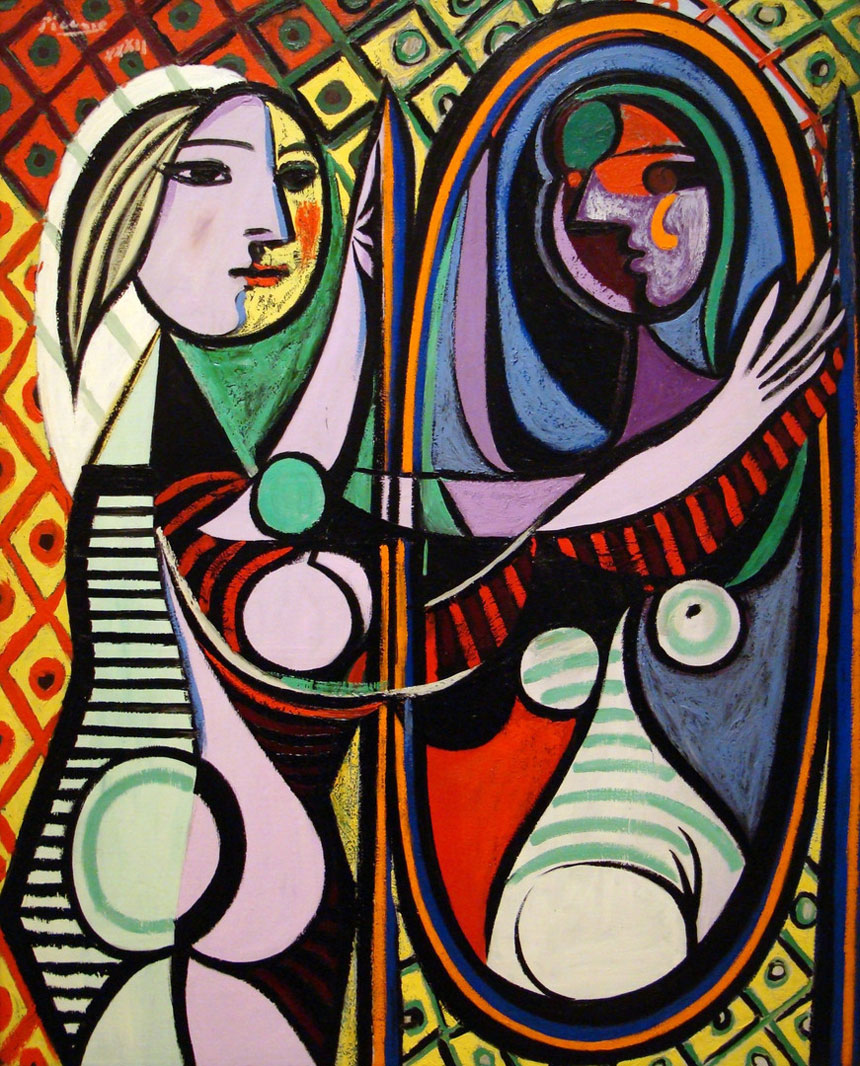
            I was most intrigued by the concept of continuously changing ways of life as time passes. We can mainly visualize this through the modernistic period of Paris. We went over multiple ways in which Paris changed when it went through its modernistic period. Two are its music and art. Music before the Modernistic era was mainly based off of a religious context. As time went along, music changed from religious melodies to a smooth, never before heard type of music called Jazz. Jazz was played by multiple people and could be played in a relaxed setting like clubs. Religious music was only played in a sophisticated setting. Art changed as well. The traditional ways of art was realistic paintings with a twist of religion. Once it was modernized it became abstract and colorful. A painter we all know is Pablo Picasso. His paintings are some of the many that came out of that time period that challenged the traditional ways of art.

            The Changing of Paris’s cultural norms as it grew reminded me a lot of myself as an individual and everyone as a society. No one has the same ways that they had as children when they are teenagers and most adults don’t have the same ways as they did when they were teenagers. I know I’m always changing. For example, I used to love tomatoes as a child. I would sit with the refrigerator door open eating a tomato like it was a peach. As I grew I’ve come to not enjoy them as much.  It’s almost as if the traditional cultural norms of multiple societies like the artistic values of Paris, in a way, have become the Parisian’s tomatoes.  Being able to go to Paris and see how much it has changed now from its original Modernistic era puts the cherry on top of everything because I will be able to visualize firsthand the transformation of beautiful society.

            Maybe we should all start looking at ourselves and our community more to see how we’ve changed. Is it a positive or negative change? If it’s negative what can we do to change it? There’s always a way and we aren’t perfect. So what can we do to change the ways in which we live to have a more positive view.
                                                             
http://www.themost10.com/wp-content/uploads/2012/03/Girl-Before-A-Mirror-By-Pablo-Picasso.jpg?359737
http://luxetravel.wpengine.netdna-cdn.com/wp-content/uploads/2012/10/Apollo-Gallery-at-the-Louvre.jpg


http://www.amigos-museu-sbras.pt/images/Goodtime%20Jazz%20Band%20poster%20-%204th%20March%202007.jpg


0 comments

I Want to Take My Talents to France

Hey, my name is Kyson Barnes and I want to take my talents to France. The architecture, language and especially the food has always made me want to live the reality I saw in the pages of books and magazines. France being an earlier developed country has a history unlike the United States. The history of France dates back to around 250 BCE which means there are tons to information to learn .I’m applying for the Transforming Youth Through Travel Scholarship because being able to travel to Paris is an opportunity that could impact my future of becoming a chef and a culturalist. Upon receiving the scholarship and actually going to France I look forward to exploring the Fashion Capitol. 
http://www.complex.com/style/2014/07/apc-kanye-fall-winter-2014-collection-3

 I’ve been interested in high fashion since around 9th grade but there’s been a barrier in that interest. I live in Sacramento. I’m almost positive Arden Mall doesn’t have high fashion boutiques or maybe I just haven’t been their enough. I also look forward to learning about the history of Jazz in Paris . Last year I started listening to jazz and neo soul after my mom told me I needed to listen to more than just hip-hop


http://revive-music.com/2010/11/15/rare-live-recording-the-robert-glasper-experiment-at-55-bar/

What drew me in were the blended sound of the saxophones and the mellow tones of the bass in the background. Until the seminar last week I actually had no idea that Paris had such a intricate history when it came to the jazz art form.

           During the seminar I was confused on how I would construct my blog and what I would write about but as Mr. Wilkinson continued to explain aspects of the Lost Generation and Modernism in Paris and America I realized I could form a legitimate theme across multiple subjects we discussed. I focused in on the specific art forms of jazz music and abstract art .During the late 1800’s toward the early 1900’s Europe specifically Paris, France was going through changes socially that were bigger than the development of both art forms. 

http://themidwestmaven.com/2012/07/22/seven-super-shots-photo-challenge/

       During this period France was going through industrialization which left many people displaced in altered lifestyles. Many people were used to a rural lifestyle but during the industrial revolution people began to be employed by large factory based companies and the urban population grew .With a more densely populated location ideas were more diverse  and information was transported faster which caused French art forms to become distorted .Looking at a piece of art from the early 1800’s next to an abstract art piece of the 1900’s you can recognize significant differences, just like you can listen to the classical music of traditional Paris then listen to jazz of Paris and can tell obvious differences. Both changes stem from the growth of communal diversity and were established because of a wider spectrum of recreational acceptance. I found this theme of change very interesting because both art forms are different but went through the same evolution.
 I ran into a temporary barrier when it came to relating this idea of change to modern times or me.

    I have had an interest in drawing and painting since I was young. But as I got older I noticed those just weren’t areas I was gifted in  . . . Music on the other hand I’ve pursued a little but haven’t really invested myself in pursuing the craft. I played the saxophone for 2 years in middle school and played the guitar for two years (8th and 9th grade). Music is still something I am passionate about but sadly procrastination is also a part of my magnificent traits.

     So I kept thinking about topics similar to my theme and that are relevant to more modern times. I noticed that the change in music and art in France happens frequently all over the world. I specifically thought about hip-hop. Hip-hop has evolved immensely since the 80’s and 90’s. I feel it has changed just like traditional music and art of France. Hip hop began with more lyrical approaches and strictly boom-bap beats that some say all sound the same. 


http://www.vibe.com/2015/03/read-the-butterfly-poem-that-kendrick-lamar-wanted-tupac-to-hear/

      Today the style has changed and the beats include faster snares and lots of bass with the lyrics consisting of less meaning (that’s why I choose to listen to artist like J Cole, Capital Steez ,and Lauryn Hill who actually have a message).Many older artist have issues with new rap music and don’t like the changes with the music similar to how some citizens of Paris in the lost generation stuck to old ways.

      Making the connection of Paris art forms changing to the development of hip-hop made me and look forward to visiting France even more realizing that French history is relevant to modern times .Sitting down and having Mr. Wilkinson discuss France with us was a lot more exciting than sitting on the computer researching .It made me mentally go through what one of the walking seminars would be like with a docent right by your side.

     This is a little random but does anybody know if there are any well-known French jazz and hip hop artist today?


Friday, October 9, 2015 2 comments

France and the Lost Generation


I applied because it is a wonderful once in a life time opportunity. I am an avid reader and writer and this will broaden my horizon and help me be a better writer. I would not be able to go to France without this scholarship. You see my family does not have a lot of money my parents have been working very hard to provide for their four children, but have had a few setbacks. My dad works long hours, sometimes six days a week. My mom was laid off from two jobs and went back to school to get a better job. My parents are also helping support my sister who just started college. I also applied because one of the only teachers who really pushed me towards success and supported me loved France.  Since she was so influential to my success, it would mean a lot to me to see and experience the same awe inspiring feelings she experienced in France.  I look forward to having an exciting experience by trying new foods, learning new facts, adding pictures and experience to previous knowledge, getting to know more people, making lifelong connections, and being influenced and apart of another culture. Some of the new foods I look forward to trying are   formage, pain au chocolat, and crepes. The new pictures I would like to add are Sainte Chappelle (Figure1), Eiffel Tower (Figure2), and Louvre (Figure3).  


The new facts I would like to learn are how people in France respond to the biggest tourist attractions, if people who live in France ever visit some of the attractions in France, and do people all tend to have the same answer with what is their favorite sport. Some people I plan on getting to know are: the person that wins with me, the docents that teach me, and the chaperons that watch me.  Lifelong connections I want to make are with the Context Travel docents. I would like to be influenced by the fashion, morales, and outside views of America.

                      The most interesting topic discussed at the seminar, Wednesday October 7, 2015 was the lost generation. The lost generation is the generation after world war one happened, which includes the people that were in the war, the people that were at home during the war, and the people that were born after the war.  The lost generation had no morales and no order.  It lead to no use of common sense, there was no common knowledge of right from wrong. The people that came back from war did not want to talk about what happened or what they had seen, so any knowledge that they had, they kept to themselves. They had seen and experienced so much devastation they couldn’t work up enough strength to tell what they had been taught before the war because during the war it had been crushed. The people that did not go to war yet saw the destruction from it decided to abandon their morales realizing there was no need for following something that was constantly being broken and saw people coming home devastated or dead. People born right after the war were born with no direction any guide lines to follow. When they looked for direction they would constantly look up and see people gorging themselves with alcohol and parties, most of the time people tend to turn towards alcohol or a new art form in order to cope with what happened after a war. Ernest Hemingway the author of the novel The Sun Also Rises, wrote, “The road to hell is paved with unbought stuffed animals.” This means that when people choose to leave innocence behind or when innocence is left behind it tends to lead people to destruction. In the bible it says one has to be like a child in order to get accepted in to the kingdom of heaven. In the quote stuff animals can be seen or interpreted as childhood innocence. If one does not buy a stuff animal it can be seen as not having innocence or leaving innocence behind. If one does not have innocence than one cannot be like a child. If one is not like a child then they cannot be accepted into the kingdom of God. If someone is not accepted to go into the kingdom of God then they go to Hell.  Hemingway writes this in order to guide the lost generation. He knows they have no morales and no common sense of what is right and what is wrong. What he also knows is their innocence is constantly being left behind or destroyed by the previous generations mess. Hemingway is guiding them to keep their innocence. He is trying to tell them do not try to grow up fast and drink or party your life away enjoy being innocent.  He is also telling the people who lost their innocence that they can still get it back all they have to do is start doing what they know is right in their heart and tell others their knowledge of what didn't work in the past and what should be done in order to not repeat the past mistakes and ultimately lead to another war. The lost generation was interesting because the generation today seem to be similar to that generation. A lot of young people today have no guidance and give up their innocence easily not by choice but because society chooses to keep them in the dark. If we had more writers like Hemingway, would we have another lost generation? Did Hemingway write to help the lost generation, or to mock their ignorance? Would Hemingway consider himself as a religious person? Is Hemingway even aware of the correlation between what he said and what it says in the bible? Has he ever read the bible? Did the ideal subconsciously pop up out of his mind or did he think about that verse directly and write it? 

Wednesday, April 1, 2015 4 comments

Nomandy War Memorials: The Peace After the Storm


Today I stood on American hallowed grounds – the Normandy American Cemetery and Memorial. Seventy years after the end of World War II, Normandy beaches Sword, Juno, Gold, Omaha, and Utah display a serene landscape. Standing on the gorgeous beaches was so surreal – the peaceful surroundings did not match with the tumultuous history.  Running toward the hills on Omaha beach allowed me to better relate with the experience of the soldiers who stormed the beaches on that dreadful day, now known as D-Day.

German bunker with gun
Photo by: Jessica Hardy
During World War II, D-Day commenced on the beaches of Normandy, in the North Western region of France, as the Allied forces wished to create a new war front and eventually capture Berlin. All that is left today are the remains of German bunkers and war memorials.

However, what personally caught my attention was the contrast between the American and German memorial cemeteries.  The Normandy American Cemetery and Memorial helped me to realize the devastation caused by D-Day (and World War II in its entirety), as more than nine thousand white crosses graced the green landscape in front of me.

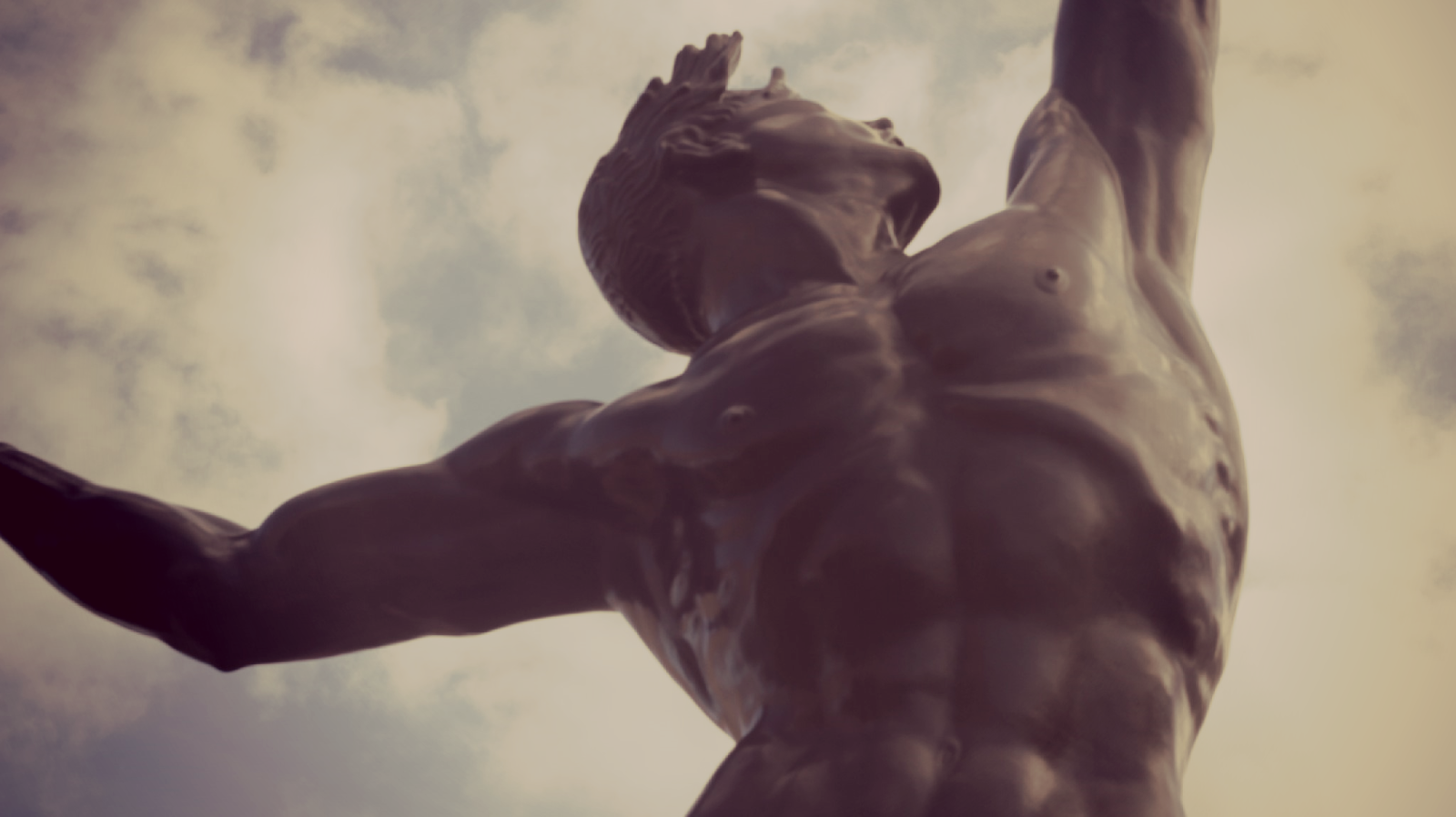
While I shivered at the sheer number of the dead, the statue named the American Young Rising, with hands and head facing towards the heavens, complemented by row upon row of erect white crosses, portrayed a sense of victory and glory.
American Young Rising Statue
Photo by: Jessica Hardy
I was deeply moved as the US national anthem, followed by Taps, began to play in the background. I felt an enormous sense of pride and gratitude as I stood on not only a war memorial, but also an active war zone from World War II. No longer was D-Day just words in a history book, but tangible words on a tombstone.

However, I was quickly reminded that the American casualties were minute in comparison to those of the enemy. When I entered La Cambe German War Cemetery, which is not far from the Normandy American Cemetery, I knew that I had entered the sanctuary of the defeated. Instead of an individual cross for each dead body, two to three Germans share one plaque. Groups of worn stone crosses present a solemn mood. Our guide made an interesting observation. To him,  the narrow passageway to the cemetery which allowed only one person to enter at a time symbolized that death takes its prey one by one.


Grave of Unidentified Body at Normandy American Cemetery
Photo By: Jessica Hardy
It is easy for people to blame the war on the Germans. Although the casualties worldwide were both monstrous and tragic, spending time at La Cambe German War Cemetery helped me to realize that both the German and American soldiers were similar in some ways. These soldiers never asked to come to the grave and sacrifice their lives. Many of the soldiers in La Cambe had just turned eighteen when they took their last breath. I wonder how many German soldiers knew that they would give their lives for a lost cause.

In hindsight, D-Day will never be the same in my mind. Although I will never experience the war for myself, being able to touch the German guns and see the American cemetery has allowed my knowledge of history to become a reality. There is nothing more touching than these words inscribed on a tombstone: “Here rests in honored glory a comrade in arms known but to God.” Through this experience I have realized the raw definition of sacrifice. Sacrifice is the nine thousand American white crosses and the twenty-one thousand German graves which grace the landscape of Normandy – the peace after the storm.


0 comments

The Paris Opera House: From Napoleon III to Chagall


As I walked in the massive Opera House building in Paris, the beautiful interior and Baroque style decor caught my eye. The interior of the Opera House is made up of around 30 different types of marble, and honors many of the most famous composers with sculptures and their names along the exterior of the buildings architecture. As I walked up the grand staircase the marble shine from the ground drew my eyes to follow the sides of the stairs to the ceiling masterpiece. I felt tiny next to the decorative lamps and statues, I had a feeling of royalty and elegance.


wikicommons: "Opera Garnier Grand Escalier" by Benh Lieu Song

The Opera de Paris represents the amazing work of Charles Garnier built from 1861 to 1875, this untested architect won a competition out of 171 applicants to plan and construct a new Opera House commissioned by Napoleon III. However, Napoleon was removed from power in 1870 and construction on the Opera Building was stopped. The planning of the Opera was composed of the style Napoleon III wanted, monogrammed with his initials, and featuring paintings that depicted his accomplishments as Emperor. Paris still needed an Opera House, and so the construction was restarted under the government of the Third Republic. It is interesting to know that the government kept the original planning that Napoleon wanted. It is a bit ironic because Napoleon was no longer in power, however, I believe that it was necessary to keep the original planning in remembrance to Napoleons accomplishments but, also to remember the rebellious act of the citizens over the Emperor and thus the Third Republic was formed.


The Opera House Grand Foyer, Photo by Jessica Hardy

In addition to the beautiful architectural style inside the Opera building, the ceiling area in the auditorium was originally painted by Jules E. Lenepveu in the late 19th century, but repainted by Marc Chagall in 1964. Chagall painted over the original painting because France's minister of Culture wanted something unique that would make the Opera house standout. The juxtaposition of this painting is usually criticized because it is different from the original structure of Garniers architectural style. However, I believe that it sets up a message that I have gotten throughout my stay in Paris: that not only Parisians but all French citizens appreciate and try to keep as much history alive. The style of the Opera House represents history, and the painting by Marc Chagall represents change. Change is an essential characteristic that is necessary to make an individual or place different from others. It is difficult to value change in its moment but it then becomes a part of a movement in life. Throughout my journey in the neighborhoods of Paris, I've learned about the evolution of the architecture in buildings and how they represent a change in the lives of Parisians.

Marc Chagall ceiling, Photo by Jessica Hardy

The size of the Opera house is huge and it made me feel like an ant next to an apple. I was awakened by the fact that there was so much to see, I didn't know where to start looking. The interior caught my attention because it has a variety of art styles in one building. As we walked through the Opera House, there were so many different forms of interior design that made me feel overwhelmed with beauty. I never thought that I would be enamored by a building like the Opera de Paris Garnier as I was. The fine points stacked up detail after detail, layer after layer of perfection.

Rebeca Vargas


;