Showing posts with label TYTT. Show all posts
Wednesday, April 1, 2015 4 comments

Nomandy War Memorials: The Peace After the Storm


Today I stood on American hallowed grounds – the Normandy American Cemetery and Memorial. Seventy years after the end of World War II, Normandy beaches Sword, Juno, Gold, Omaha, and Utah display a serene landscape. Standing on the gorgeous beaches was so surreal – the peaceful surroundings did not match with the tumultuous history.  Running toward the hills on Omaha beach allowed me to better relate with the experience of the soldiers who stormed the beaches on that dreadful day, now known as D-Day.

German bunker with gun
Photo by: Jessica Hardy
During World War II, D-Day commenced on the beaches of Normandy, in the North Western region of France, as the Allied forces wished to create a new war front and eventually capture Berlin. All that is left today are the remains of German bunkers and war memorials.

However, what personally caught my attention was the contrast between the American and German memorial cemeteries.  The Normandy American Cemetery and Memorial helped me to realize the devastation caused by D-Day (and World War II in its entirety), as more than nine thousand white crosses graced the green landscape in front of me.

While I shivered at the sheer number of the dead, the statue named the American Young Rising, with hands and head facing towards the heavens, complemented by row upon row of erect white crosses, portrayed a sense of victory and glory.
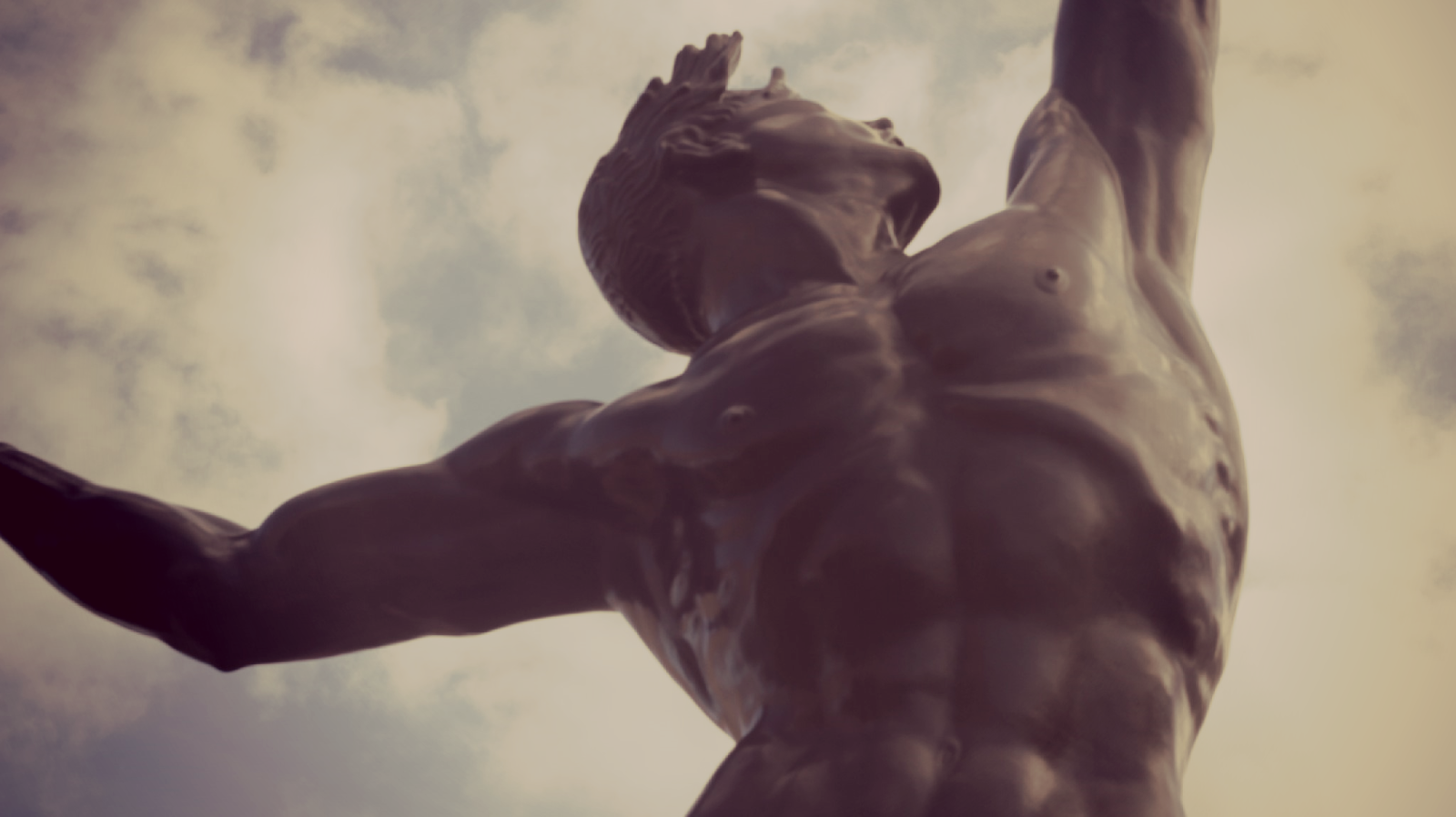
American Young Rising Statue
Photo by: Jessica Hardy
I was deeply moved as the US national anthem, followed by Taps, began to play in the background. I felt an enormous sense of pride and gratitude as I stood on not only a war memorial, but also an active war zone from World War II. No longer was D-Day just words in a history book, but tangible words on a tombstone.

However, I was quickly reminded that the American casualties were minute in comparison to those of the enemy. When I entered La Cambe German War Cemetery, which is not far from the Normandy American Cemetery, I knew that I had entered the sanctuary of the defeated. Instead of an individual cross for each dead body, two to three Germans share one plaque. Groups of worn stone crosses present a solemn mood. Our guide made an interesting observation. To him,  the narrow passageway to the cemetery which allowed only one person to enter at a time symbolized that death takes its prey one by one.


Grave of Unidentified Body at Normandy American Cemetery
Photo By: Jessica Hardy
It is easy for people to blame the war on the Germans. Although the casualties worldwide were both monstrous and tragic, spending time at La Cambe German War Cemetery helped me to realize that both the German and American soldiers were similar in some ways. These soldiers never asked to come to the grave and sacrifice their lives. Many of the soldiers in La Cambe had just turned eighteen when they took their last breath. I wonder how many German soldiers knew that they would give their lives for a lost cause.

In hindsight, D-Day will never be the same in my mind. Although I will never experience the war for myself, being able to touch the German guns and see the American cemetery has allowed my knowledge of history to become a reality. There is nothing more touching than these words inscribed on a tombstone: “Here rests in honored glory a comrade in arms known but to God.” Through this experience I have realized the raw definition of sacrifice. Sacrifice is the nine thousand American white crosses and the twenty-one thousand German graves which grace the landscape of Normandy – the peace after the storm.


0 comments

The Paris Opera House: From Napoleon III to Chagall


As I walked in the massive Opera House building in Paris, the beautiful interior and Baroque style decor caught my eye. The interior of the Opera House is made up of around 30 different types of marble, and honors many of the most famous composers with sculptures and their names along the exterior of the buildings architecture. As I walked up the grand staircase the marble shine from the ground drew my eyes to follow the sides of the stairs to the ceiling masterpiece. I felt tiny next to the decorative lamps and statues, I had a feeling of royalty and elegance.


wikicommons: "Opera Garnier Grand Escalier" by Benh Lieu Song

The Opera de Paris represents the amazing work of Charles Garnier built from 1861 to 1875, this untested architect won a competition out of 171 applicants to plan and construct a new Opera House commissioned by Napoleon III. However, Napoleon was removed from power in 1870 and construction on the Opera Building was stopped. The planning of the Opera was composed of the style Napoleon III wanted, monogrammed with his initials, and featuring paintings that depicted his accomplishments as Emperor. Paris still needed an Opera House, and so the construction was restarted under the government of the Third Republic. It is interesting to know that the government kept the original planning that Napoleon wanted. It is a bit ironic because Napoleon was no longer in power, however, I believe that it was necessary to keep the original planning in remembrance to Napoleons accomplishments but, also to remember the rebellious act of the citizens over the Emperor and thus the Third Republic was formed.


The Opera House Grand Foyer, Photo by Jessica Hardy

In addition to the beautiful architectural style inside the Opera building, the ceiling area in the auditorium was originally painted by Jules E. Lenepveu in the late 19th century, but repainted by Marc Chagall in 1964. Chagall painted over the original painting because France's minister of Culture wanted something unique that would make the Opera house standout. The juxtaposition of this painting is usually criticized because it is different from the original structure of Garniers architectural style. However, I believe that it sets up a message that I have gotten throughout my stay in Paris: that not only Parisians but all French citizens appreciate and try to keep as much history alive. The style of the Opera House represents history, and the painting by Marc Chagall represents change. Change is an essential characteristic that is necessary to make an individual or place different from others. It is difficult to value change in its moment but it then becomes a part of a movement in life. Throughout my journey in the neighborhoods of Paris, I've learned about the evolution of the architecture in buildings and how they represent a change in the lives of Parisians.

Marc Chagall ceiling, Photo by Jessica Hardy

The size of the Opera house is huge and it made me feel like an ant next to an apple. I was awakened by the fact that there was so much to see, I didn't know where to start looking. The interior caught my attention because it has a variety of art styles in one building. As we walked through the Opera House, there were so many different forms of interior design that made me feel overwhelmed with beauty. I never thought that I would be enamored by a building like the Opera de Paris Garnier as I was. The fine points stacked up detail after detail, layer after layer of perfection.

Rebeca Vargas


Friday, March 27, 2015 0 comments

Stones Below Paris


As we walked through the diverse city of Paris, we were able to see huge buildings and cute cafes. The smell of delicious pastries drew us in every morning to our neighborhood boulangerie to buy croissants. Walking narrow and wide streets through the different arrondissements, I could see the way Parisians go about their day. Making mistakes on the metro, walking into stores saying bonjour and merci is an amazing experience. One of the best ways to experience and absorb the culture is to interact with locals. A great way to connect with a new city is by understanding its history. Context Travel does this for the intellectually curious traveler. The process of Paris becoming a city that values history, by keeping and; restoring historical buildings and objects, is lovely. By understanding the birth of the city of Paris, individuals can connect with its history. Here, I’ll share two Context Travel tours that greatly influenced the way I see the city – and the world.


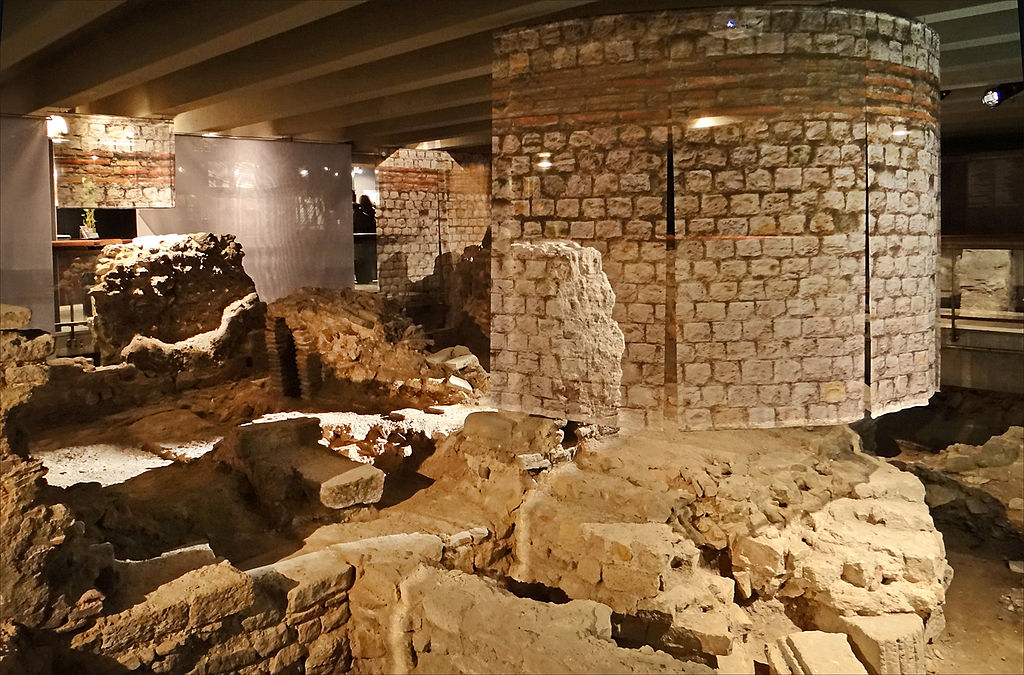
Crypte.jpg
"La crypte archéologique du Parvis de Notre-Dame (Paris) by dalbera from Paris, France
Wikimedia Commons


The Birth of the City of Light walk with Context Travel gave us an overview of the Roman city of Lutetia, located in the grounds of what is now Paris in the Ile de Cite and mainly in the left bank. This walk had many interesting facts about the Roman city. However, visiting the Crypte Archeologique was breathtaking. Our docent shared the history of the city of Lutetia. It was discovered when Parisians were digging to create more space, and fortunately found the remains of the ancient Roman city. The remains of the ancient city showed how stones were set up to create the city. It was interesting to learn the way Lutetia kept expanding in a circle, like rings of a tree trunk, with the Ile de la Cite in the center. Many Roman structures are still used in Paris, including; the Roman city planning main north-south-oriented main street called  cardo maximus. The process of seeing these ancient sites and then comparing it to the innovation of the buildings above throughout time made me think about what the world values. Paris appreciates the beauty of original buildings and makes them accessible to the public by having major museums free of charge for children and students. More places should follow this structure of having accessible sites for young people, it gives individuals a chance to explore and learn outside of school.   
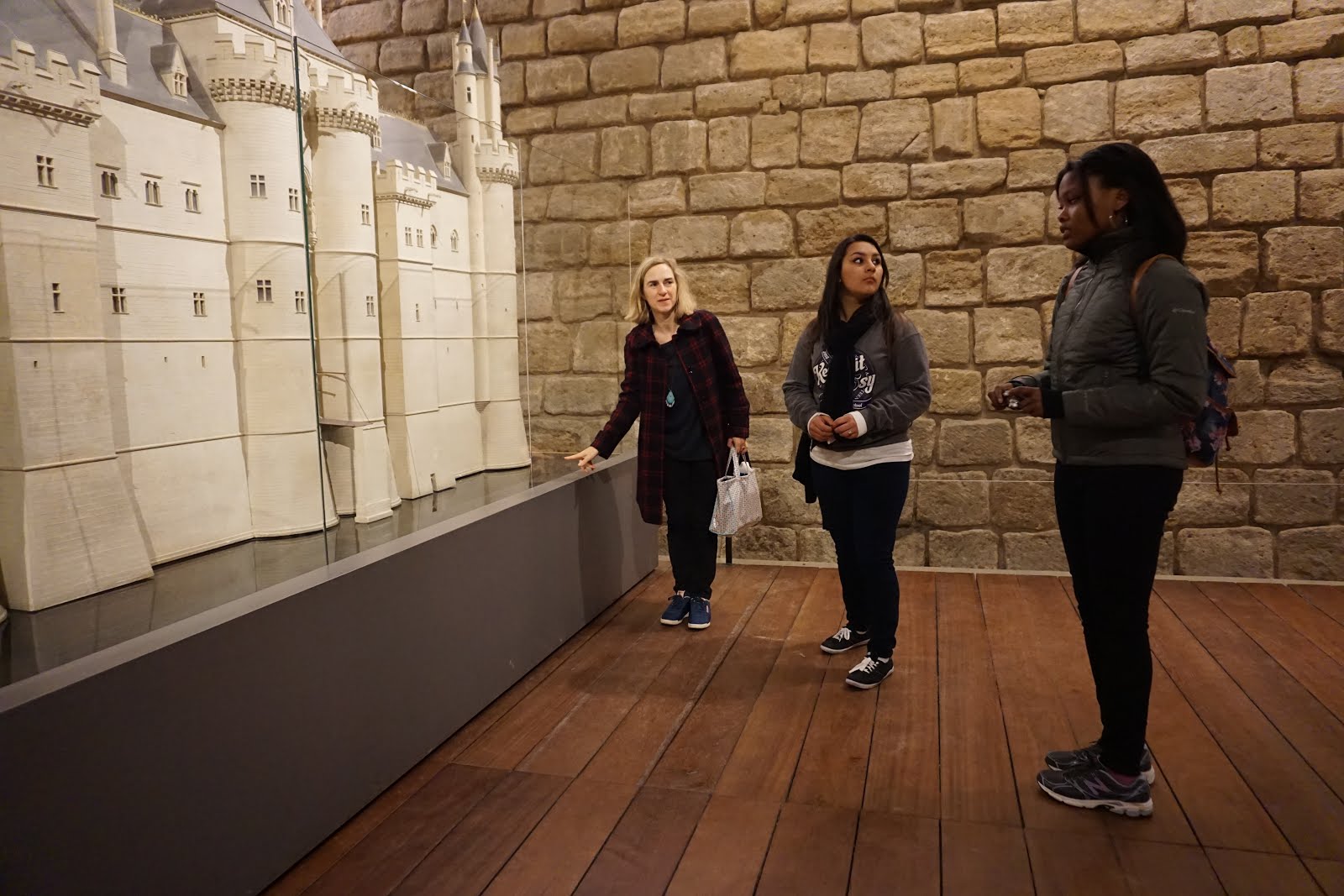
DSC00168 - Copy.JPG
Louvre medieval fortress photo by Rebeca Vargas


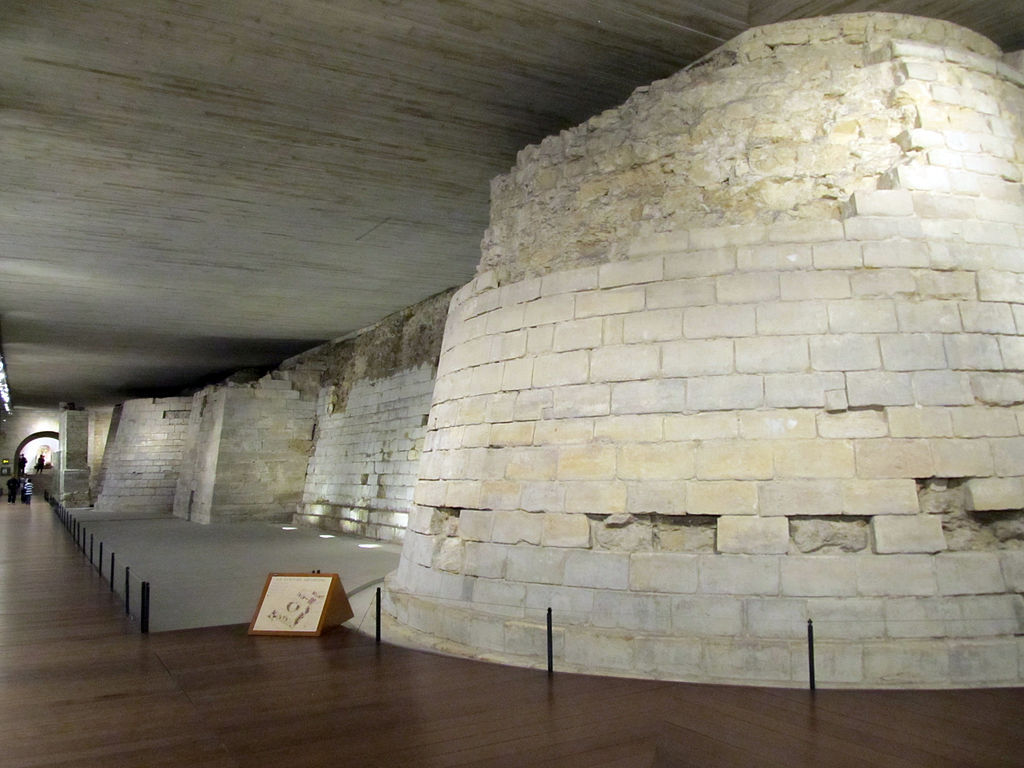
The Louvre Crash Course walking seminar started by entering the newly discovered medieval fortress under the famous museum. This part of the walk held my attention because it was underneath the Louvre for a long time until it was discovered in the 1980s, when the glass pyramid was added to the beautiful museum. After learning about the medieval fortress, the history of the rest of the Louvre fell into place.
LOUVRE FORTRESS.jpg
"Fortress remains, Louvre, Paris June 2014" by daryl_mitchell from Saskatoon, Saskatchewan, Canada
 Fortress Remains-Wikimedia Commons


The amusing part of the discovery of the fortress is that it was not planned. The discovery of most remains of historical buildings in Paris are opened for the public to explore and learn about the past. I wonder if I start digging in my backyard, what will I find? I have grown an interest in the findings of historical buildings and objects. I have created a new challenge or added to my bucket list, to go back to the Louvre and learn about the artifacts there that we did not see today. Realistically, it will take me more than three days because the Louvre is huge, but I am up for the challenge and will return to the City of Light later in my lifetime. How long do you think it takes to go through the whole Louvre? 
0 comments

Notre Dame: Holy Museum?


Entrance to Notre Dame
Photo by: Jessica Hardy
   When thinking of Notre Dame, one might picture ornate spires, rusted gargoyles, and monumental entrances. I, too pictured this in my head, in anticipation for my visit to Paris. While I did found these characteristics to hold true, Notre Dame was also overrun by various less appealing characteristics as well.
   Upon approach, Notre Dame offers a spectacular entrance, second to none, characterized by three doors ornate with not only biblical and historical sculptures, but also royal motifs. The cathedral’s larger than life appearance excited my architectural passions and beckoned me to see more. Once inside, however, I witnessed first-hand the results of the presence of tourists and holy relics in one city. While the nave of Notre Dame is nothing less than an impressive showcase of both Romanesque and Gothic architecture, I was easily distracted by the presence of the crowd, murmuring and snapping pictures. I will not lie, I took pictures too; but I was constantly pervaded by the thought – this was not a gothic cathedral.
Ceiling at Notre Dame
Photo by: Jessica Hardy
  

   During medieval Paris, the Catholic clergy had Gothic Cathedrals constructed with massive stained-glass windows, colossal columns, complex ceilings, and dimmed lighting to create a supernatural experience for Parisian commoners, making the individual minute in comparison to the church. However, the presence of camera-snapping tourists and church-related advertisements coinciding with serious Catholics performing prayers and visible confessionals created a quite uncomfortable juxtaposition. Such a contrast provided no room for the reverence due to such a holy building. I had expected a holy cathedral and found a “holy museum”?
   
Alter at Sainte-Etienne-du-Monte
Photo by: Jessica Hardy
Even though Notre Dame did not satisfy my preconceived notions, I still highly recommend visiting the cathedral for its sheer scale as well as its biblical and historical symbolism. However,  I found that the smaller cathedrals around Paris present a more personal and traditional experience. For example, the Sainte-Etienne-du-Monte is a church in Paris, located on the Montagne Sainte-Geneviève in the 5th arrondissement, near the Panthéon. Although much smaller that Notre Dame, it contains the shrine of St. Geneviève, the patron saint of Paris. In addition, its’ smaller scale allows a more individual experience. I also found that I was able to enjoy the ceremonial mass, the lighting of the prayer candles, the symbols of the stained-glass windows, and the solemn atmosphere in a quieter, more traditional space. Who knew that I would find what I was looking for at Notre Dame in a smaller, less famous church – home to the patron saint of Paris? On second thought, that makes perfect sense.
Sunday, March 22, 2015 0 comments

2015 Scholarship Winners Prepare for Paris

Within 24 hours, Jessica Hardy and Rebeca Veliz will be in route to Paris. After three months of preparation classes, Context walks research, variety of readings and films, these two girls are ready to land in the City of Light.  Although it is challenging to write about a city that you have yet to see in person, each student wrote a pre-trip blog. Thanks to Dr. Jessie Voigt for working behind the scenes to assist students with their blogs. 

Check out Jessica's post, titled, From Cardboard Box to Notre Dame Cathedral


Wikimedia Commons: By Freepenguin


It is so funny how over time we grow and our minds tend to change. However, there are some passions that never leave our heads, those reoccurring dreams that we want so much to be a reality.
When I was about ten years old, I took the liberty to go through my mother’s mail. Upon finding an architectural magazine, I began to look through it… and every single house plan and style seemed to catch my attention. Some I fell in love with, some I hated. As a ten year old, I began to have an opinion about the world of architecture.
To read more, see Jessica's blog post, click link below.  Featured on Wandering Educators

Check out Rebeca's post, titled, Monet to Banksy: From Impressionist to Street Art
Auguste Renoir - Dance at Le Moulin de la Galette, 1876, oil on canvas, 131x175cm - Musée d'Orsay RF 2739 (derivative work - AutoContrast edit in LCH space). Wikimedia Commons

Cafés in Paris, France in the 19th century served as a place where individuals gathered to talk about painting, literature, and politics. In the corner of a Café, a group of young artists (who later became known as Impressionists) shared their dreams and aspirations in the art world. Their dreams included becoming professional artists, with their art works being accepted and displayed in the Salon, however they faced rejection from the art community. Many Impressionist artists, like Renoir and Monet, didn't go to traditional schools of painting - they went to studios that artists opened for young artist to use. Despite their rejections at the Salon, they didn't give up - and now their artwork is displayed in famous museums in Paris and around the world. Their ambition and grit helped them achieve success. The Musee d'Orsay is one of the museums that displays Impressionist works.
To read more, see Rebeca's blog post, click link below.  Featured on Wandering Educators


Wednesday, June 18, 2014 0 comments

Malik's Reflection: 2014 TYTT Co-Recipient


A few things I have gained through going through application process twice is perseverance. I had a strong desire to win. After losing the first time I realized that I really had to utilize my time into perfecting my assignments and not procrastinating. This was a good craft to perfect because its comes up in life all the time.  Procrastination always played a big role in my daily life style, and after going through this process I felt like not only did I improve on not procrastinating, but I learned through perseverance I can conquer any task at hand. In preparation for the trip we had meetings and gained a lot of information on Roman history. Through the required reading in preparation for the trip I learned that Bernini and Borromini basically framed the foundations of Baroque for Rome. Those two artists were basically involved with everything.  Also we researched a lot on the potential walks we were going to participate in while in Italy. It  was cool because I felt I was prepared for the content the docents would teach us before they explained it. 


Overall I feel like this trip had really changed me as a person. Even though I had the chance to taste the most amazing food In the world I still had this strange attraction to art. Returning back from Rome I just didn't  see things the same way. When I look at building it's nothing compared to the ones in Rome. And when I eat pizza or pasta or even just drinking water I realize it's just not the same as Rome. And in all honesty I really miss it and I really want to go back because I had a true connection with everything I learned. Having the chance to travel to a whole different country at such a young age has really impacted me. This experience will live with me forever, and all the knowledge I acquired will forever remain in my mind. 

After the trip we made reflective videos of what we sought most interesting this also was a good lesson for the future. Now I'm more familiar with Macs and Final Cut Pro. I know the ins and outs of the audio and video for apple computers now.


Tuesday, June 17, 2014 0 comments

A Day I'll Never Forget

August 26, 2008


When I say that today changed my life, I mean it. The artwork I saw; the emotions I experienced, the conversations I had, they are things I will never forget. They day began early, out of the apartment by 8, a quick café latte and off to the entrance of Vatican City by 8:45.
Our first tour was three hours in St. Peter’s Basilica. And although that is probably all the learning we could handle without our heads exploding, it felt like not enough time. The church has so much history of the Christian church and the Popes and the artists who were commissioned to design it and create art for it. For those who don’t know, St. Peter’s was built on the site where the Apostle Peter was said to have been martyred. Going to the church, I hadn’t known that Bramante was the architect, Bernini designed the piazza, and that Michelangelo designed the dome; and it was fun to realize that it was all dedicated that man who denied Jesus three times, but then became “the rock on which [Christ] would build [his] church.” Walking inside the basilica is stunning; the dedication that went into creating such a magnificent structure is mind blowing.
After a short break to process our thoughts, and a quick bite to eat of fine Italian cuisine, we headed out for the Vatican museums. Now this was the one I was waiting for. My favorite piece of art is in there and I had butterflies in my stomach.


Going through the Vatican collection was really great because when people go to the Vatican all you hear about is the Raphael and the Michelangelo pieces. But all through the museum are fabulous altarpieces and sculptures and paintings by great artists all throughout history. There was definitely a lot more to it than I had thought and it was took us a good two hours to learn about only a fraction of the collection. Finally we moved into the rooms of Raphael, my favorite painter. The Pope had commissioned him to paint his waiting room, his personal room, his library, etc.—and Raphael truly outdid himself. My absolute favorite piece is his School of Athens in which you see a variety of different scholars and great minds from history. I did a report last year in school on the piece, and after today I feel like I barely scraped the surface in my research. That’s what is so amazing about art history. There is not always one right interpretation of the meaning of a work of art. I had my own theories formed, but then I heard the theories of our docent, as well as those of another scholar from England, I realized that none of us are necessarily correct. We can only research and discuss the meaning, but it is so much fun to do so!


Next of course was the Sistine Chapel. Michelangelo painted the ceiling at age 30 and the Last Judgment wall was painted by him at age 60. I’m thinking that the papacy liked his work. As I entered, whatever the docent leading our group said, I did not hear. I had to walk to the bench and sit down. As my eyes filled with tears, I opened my journal and wrote, because I knew this would be a moment I would never be able to experience again. Here’s what I wrote, “The Last Judgment in real life! My God! I can hardly write this now because my hand is shaking so much. I can hardly explain what I am feeling right now. Joy, awe, reverence, and disbelief in being here. I am here, in the same room where Michelangelo worked for so many years, and I am speechless.” The emotions I experienced were so new to me I could barely speak the whole way home. What a day!
Also, thanks to all of you who are writing comments to these blogs, they are really encouraging for me to read.
Ciao!

Katie Estabrook (Hagstrom)
0 comments

Layers Upon Layers of History

August 25, 2008


It’s crazy to think I have only been in Rome for 4 days! It feels like it’s been over a week. I’m seeing so much and learning so much and experiencing so much that it’s hard to take it all in much less even believe it’s all really happening.
Today was amazing. I learned so much about the history of the city in relation to the church, and Constantine, and the Rise and Fall of the Empire. But what really stuck out to me today was the fact that this city is truly unlike any city in the entire world. It is so incredibly unique in its history. For most places, all the history is in books. In Rome, it’s there in the physical. Only in Rome can you walk into an 18th-century church and then go downstairs to a 4th-century church. Someone was digging a grave next to the church and their hole opened up into a huge chamber that turned out to be just another ancient basilica. And  what is even crazier is that below that, they found more. There was a 1st-century villa and then a public building, which was most likely the mint. And if you were to keep digging there would only be more and more layers.
In Rome, they didn’t demolish one building and then build another, they just filled in the old with rubble and built more atop it. I find it mind boggling that it is the same everywhere in the city. You could essentially dig anywhere and find more and more history. That is why it’s so difficult for them to build a subway. They already have two but they were trying to build another one recently and found  huge marble steps buried in the ground. How incredible is that?
Another way that we saw history was passed on was through frescos. One place we visited, which is now a convent, had a chamber with a story of Constantine wrapped around the ceiling in fresco. Although most of the story is now known to be false, it was popular belief at the time, and that’s how things would be passed on, through painting. Especially since many people could not read or write.

In the evening we once again had our Italian Language workshop. Each time we have this class I get a new perspective on something vitally important. Tonight it was the amount of influence language in Italy has had on its history and its culture. Andrea shared with us all the original languages that varied according to region, then he showed us what happened when Rome expanded and  took on Latin as its model language. We saw how local vernaculars combined with Latin and formed new languages. Italy has gone through so many language transitions back and forth  that it is hard to know what the model language is for the country. And it’s very interesting to learn that even Italians sometimes can’t understand each other if they are from different regions.
What a unique country this is! We are having an incredible time here and I can’t wait for tomorrow morning to see St. Peters and the Vatican! Ciao!

Katie Estabrook (Hagstrom)
0 comments

Standing Amongst History

August 24, 2008


Now that we are a little more familiar with the way things work here, particularly the bus system, transit around Rome is going quite smoothly. We are learning to adapt and find our way around, mostly by trial and error.
Our tour today was the Capitoline museums. I think one of the biggest things for me was seeing the excavated findings of Constantine. In the first courtyard that I walked into I saw a giant head, arm, hand and foot. Not pieced together, but just arranged there in the court in their own pieces. What got me was the fact that people really had statues of themselves made of such grandiose size. And the other thing was that I was trying to think of how amazing it would be to be the one who unearthed such a structure. How amazing to find a glorious portrait of such an infamous man. Its things like this statue that made Constantine eternal and godlike.
I also learned a ton about Rome’s history about how it began, the Roman Triad, and the rein of the many emperors. We saw the famous she-wolf and the suckling infants below of Romulus and Remus. To see the bronze sculpture that shows the legend of the founding of the great city of Rome is truly wonderful. Its not that the statue is worshiped, but rather it’s a sign to the people to remind them of their history as a city divinely appointed for greatness.
One of the most interesting things I learned about was the Triad of the gods Jupiter, Juno, and Minerva and how the three worked in perfect harmony. The most powerful part of the tour was in the room of the museum where parts of the original foundation of the temple of Jupiter remained. We were standing in what was the substructure of the largest temple in Rome. Its like there was so much history there, and we weren’t just standing in a place where something great used to be, we were standing there with the remains of the original building. My breath was taken away just thinking about where I was standing in context to the story of Rome. The temple of Jupiter was such a monumental structure for the people in and around Rome in ancient times and there I was, right alongside history.
As far as emperors go, it’s really easy to get confused at all the different ones and to try and keep a timeline of when and for how long they all ruled. So today I didn’t learn about all of them, but I learned important things about emperors that really made changes in the empire or brought new ideas. I found the tour through Context: Travel not just to be a boring list of the rulers, but rather a great deal of interesting facts about a few of them, which kept me interested and wanting to learn more. And that I think it is key; to make the ancient people alive and show how they were like people today. In ancient times men were power thirsty, they loved, they committed adultery, they conquered, they worked, they educated themselves, and they are just like us in many ways.


In the evening we went for a passeggiata, or stroll, with two marvelous docents who answered every question we had about Rome’s history and showed us to notice key things throughout the city that we wouldn’t have paid attention to otherwise. Traveling with someone who has lived here and studied the past of this city can truly open your eyes and show you parts of the city that general tourists aren’t lucky enough to see.
With the way things are going so far, I’m looking forward to the upcoming days with such great anticipation.

Katie Estabrook (Hagstrom)
0 comments

DID I REALLY JUST SEE THE COLOSSEUM?!

August 23, 2008


Today was unreal. I can’t believe how lucky I am to be here in Rome. I have experienced things in a single day that many people don’t get to experience in their lifetime.
The day began with a bit more culture shock. We needed to buy some bus tickets to take us to the Colusseum, but when we got to the shop where we were told we could purchase them, it was closed. It was already 8:00 in the morning and we had figured everything would be open by then; but once again, things are different in Italy. Not every store is open at the crack of dawn and closes at midnight. People are more relaxed and come to find out, many of the shops close for siesta right in the middle of the day! This is so different from our American culture where things are open practically all day as to bring in the greatest profit. So, we didn’t have tickets had to call a cab.
Driving in the cab I had my video camera and was filming out the window, but all of the sudden Kim nudged me and said, “look.” I put down my camera and looked straight ahead. There it was, the Flavian Amphitheater, also known as the Colosseum. I was breathless. To think that I really saw the Colosseum up close and in person has still got me in shock. The fact that the structure was built in less than ten years, before all of our modern technology, is absolutely remarkable. My favorite thing about the Colosseum tour was learning whether or not all those rumors I had heard were true or not. Come to find out they really did fill the basin with water and re-enact battle scenes, and they in fact, did not murder Christians by the hundreds, that is a myth. The Romans were violent, but they were not inhumane. It was interesting to learn about how history is recorded and its not always accurate depending on who the source is.
As we are becoming more accustomed to life here, we stopped at our local store for some dinner. We bought bread, olive spread, Gouda cheese and my favorite, prosciutto, a cured meat that tastes absolutely heavenly.  We made our own little sandwiches and felt very Italian. Later in the day we headed out for our Italian Language workshop with Andrea. What an amazing new perspective on language and Italian culture. Andrea brought to us an approach for learning Italian like I had never heard before. He didn’t jump right into grammar or basic sentences or salutations, because he knew that learning how to say “where is the bathroom?” would do you no good if you couldn’t understand the answer. So, he taught us about the way Italian is similar to English in that they both have Latin roots. We began to compare similarities and differences with the words and the sounds. Learning from Andrea makes me realize how as Americans we try to talk so fast because we don’t appreciate our language; we are more focused on getting things done. As Italians, they view every single consonant and vowel as essential to the word. Italian spoken by an Italian is like music. After this we were so pumped up about learning the language that we practiced on everyone we could on the way home.


After getting off the bus we got an extra little treat that we weren’t expecting. It’s Saturday night in Italy, and we had totally forgotten about the night-life! We walked through the market and bought jewelry and talked to people. We met two young men both from Egypt who were most interesting and made great interviewees for my documentary. And the night didn’t stop there. We headed to the festival tents set up along the river by our apartment. We saw some quaint little shops and then a class of dancers learning how to salsa right on the riverfront. How romantic!
I sit here writing this blog just being so thankful that I got the wonderful opportunity to be here and its more than I could have asked for.

Katie Estabrook (Hagstrom)
Friday, June 13, 2014 0 comments

Katie meets Rome as Our First Scholarship Winner in 2008


August 20, 2008

Our grand adventure here in Rome began today at 8:30 am when we arrived in the airport and took a speedy ride through the city to our quaint little Italian apartment in the center of Rome, about 15 minutes walking distance from all the great major landmarks and monuments. We got settled in and then Kim and I set out to explore our surroundings.
We began to realize the cultural differences right away. First we stopped for a quick bite at a street side “ristorante” or restaurant, and since the menus were all in Italian, I just picked a sandwich off the menu and I had no clue what was going to be inside. It turned out to be spinach, mushrooms and cheese, a very healthy choice. Then there was the joy of trying to figure out if we could add a tip on the receipt from a waitress whom we couldn’t understand. From there we headed to a bank to try to get some cash out. Kim inserted her card several times into the machine and entered the amount she wanted, then the machine said take your card out in thirty seconds, but every time she took it out the transaction canceled. So, she tried just leaving it in past the thirty seconds—this was lesson number two for the day. Apparently in Italy if you don’t remove your card in time, the machine eats it, and as you can imagine this freaked us out just a little. Then we walked around to the front of the bank and no one was inside. Well, eventually everything got settled and we got the cash and were able to stop and enjoy a quick cup of superb gelato. It was a bit of a culture shock, but we just began to realize that life is different here and everyone operates on a different system.
From there we headed back to the apartment for a quick power nap to try to defeat our jet lag, and then set out to meet up with our Italian guides Petulia and Jessica. They gave us an impromptu tour that turned out to be incredible. I learned so much about the history of the art in the churches and the buildings themselves. One thing I saw that I was not expecting at all were the paintings in San Luigi dei Francesi. The church was full of paintings, but at the end was a little corner nook with paintings by Caravaggio. Walking up you can only see one painting, and as we were approaching I was telling Jessica how much I loved the Caravaggio painting titled “The Calling of St. Matthew.” Little did I know that as I rounded the corner, there it was, in all its glory. I literally almost fainted because I couldn’t believe that this picture I studied so much in art history class back home was actually there before my eyes. Art truly became alive to me today and I realized that what you see in your textbook is incomparable by all means to the real thing.
From there we went on to see the majestic Pantheon where Raphael, one of my favorite Renaissance painters, was buried. The Pantheon itself was so remarkable and to think that people actually built something so complex so many years ago absolutely blew my mind.
Today was a very overwhelming day, but in the best sense. The information that I took in was priceless, and I’m only more excited for the coming days.
 
;