Showing posts with label Jessica Hardy. Show all posts
Wednesday, April 1, 2015 4 comments

Nomandy War Memorials: The Peace After the Storm


Today I stood on American hallowed grounds – the Normandy American Cemetery and Memorial. Seventy years after the end of World War II, Normandy beaches Sword, Juno, Gold, Omaha, and Utah display a serene landscape. Standing on the gorgeous beaches was so surreal – the peaceful surroundings did not match with the tumultuous history.  Running toward the hills on Omaha beach allowed me to better relate with the experience of the soldiers who stormed the beaches on that dreadful day, now known as D-Day.

German bunker with gun
Photo by: Jessica Hardy
During World War II, D-Day commenced on the beaches of Normandy, in the North Western region of France, as the Allied forces wished to create a new war front and eventually capture Berlin. All that is left today are the remains of German bunkers and war memorials.

However, what personally caught my attention was the contrast between the American and German memorial cemeteries.  The Normandy American Cemetery and Memorial helped me to realize the devastation caused by D-Day (and World War II in its entirety), as more than nine thousand white crosses graced the green landscape in front of me.

While I shivered at the sheer number of the dead, the statue named the American Young Rising, with hands and head facing towards the heavens, complemented by row upon row of erect white crosses, portrayed a sense of victory and glory.
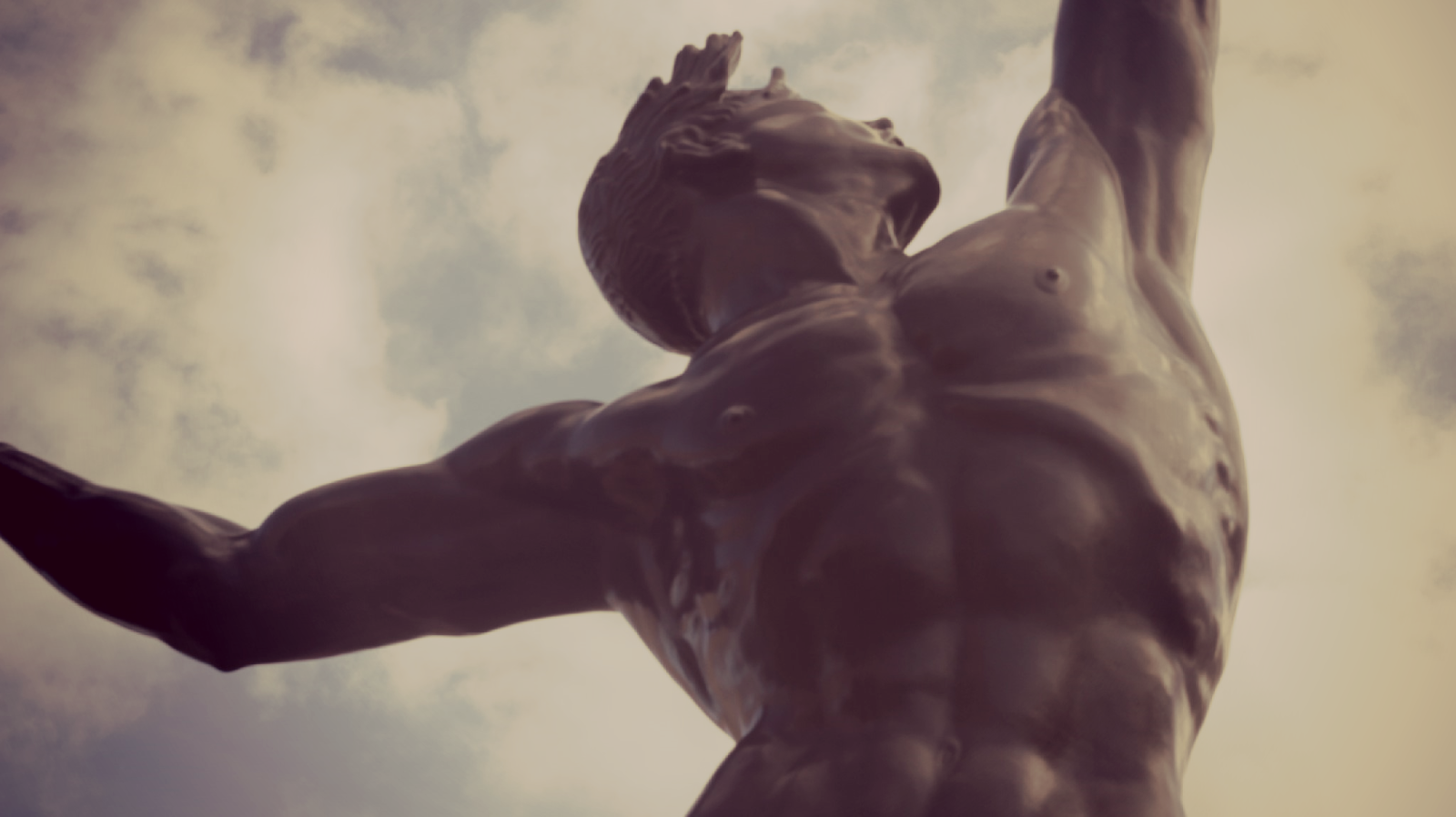
American Young Rising Statue
Photo by: Jessica Hardy
I was deeply moved as the US national anthem, followed by Taps, began to play in the background. I felt an enormous sense of pride and gratitude as I stood on not only a war memorial, but also an active war zone from World War II. No longer was D-Day just words in a history book, but tangible words on a tombstone.

However, I was quickly reminded that the American casualties were minute in comparison to those of the enemy. When I entered La Cambe German War Cemetery, which is not far from the Normandy American Cemetery, I knew that I had entered the sanctuary of the defeated. Instead of an individual cross for each dead body, two to three Germans share one plaque. Groups of worn stone crosses present a solemn mood. Our guide made an interesting observation. To him,  the narrow passageway to the cemetery which allowed only one person to enter at a time symbolized that death takes its prey one by one.


Grave of Unidentified Body at Normandy American Cemetery
Photo By: Jessica Hardy
It is easy for people to blame the war on the Germans. Although the casualties worldwide were both monstrous and tragic, spending time at La Cambe German War Cemetery helped me to realize that both the German and American soldiers were similar in some ways. These soldiers never asked to come to the grave and sacrifice their lives. Many of the soldiers in La Cambe had just turned eighteen when they took their last breath. I wonder how many German soldiers knew that they would give their lives for a lost cause.

In hindsight, D-Day will never be the same in my mind. Although I will never experience the war for myself, being able to touch the German guns and see the American cemetery has allowed my knowledge of history to become a reality. There is nothing more touching than these words inscribed on a tombstone: “Here rests in honored glory a comrade in arms known but to God.” Through this experience I have realized the raw definition of sacrifice. Sacrifice is the nine thousand American white crosses and the twenty-one thousand German graves which grace the landscape of Normandy – the peace after the storm.


Friday, March 27, 2015 0 comments

Notre Dame: Holy Museum?


Entrance to Notre Dame
Photo by: Jessica Hardy
   When thinking of Notre Dame, one might picture ornate spires, rusted gargoyles, and monumental entrances. I, too pictured this in my head, in anticipation for my visit to Paris. While I did found these characteristics to hold true, Notre Dame was also overrun by various less appealing characteristics as well.
   Upon approach, Notre Dame offers a spectacular entrance, second to none, characterized by three doors ornate with not only biblical and historical sculptures, but also royal motifs. The cathedral’s larger than life appearance excited my architectural passions and beckoned me to see more. Once inside, however, I witnessed first-hand the results of the presence of tourists and holy relics in one city. While the nave of Notre Dame is nothing less than an impressive showcase of both Romanesque and Gothic architecture, I was easily distracted by the presence of the crowd, murmuring and snapping pictures. I will not lie, I took pictures too; but I was constantly pervaded by the thought – this was not a gothic cathedral.
Ceiling at Notre Dame
Photo by: Jessica Hardy
  

   During medieval Paris, the Catholic clergy had Gothic Cathedrals constructed with massive stained-glass windows, colossal columns, complex ceilings, and dimmed lighting to create a supernatural experience for Parisian commoners, making the individual minute in comparison to the church. However, the presence of camera-snapping tourists and church-related advertisements coinciding with serious Catholics performing prayers and visible confessionals created a quite uncomfortable juxtaposition. Such a contrast provided no room for the reverence due to such a holy building. I had expected a holy cathedral and found a “holy museum”?
   
Alter at Sainte-Etienne-du-Monte
Photo by: Jessica Hardy
Even though Notre Dame did not satisfy my preconceived notions, I still highly recommend visiting the cathedral for its sheer scale as well as its biblical and historical symbolism. However,  I found that the smaller cathedrals around Paris present a more personal and traditional experience. For example, the Sainte-Etienne-du-Monte is a church in Paris, located on the Montagne Sainte-Geneviève in the 5th arrondissement, near the Panthéon. Although much smaller that Notre Dame, it contains the shrine of St. Geneviève, the patron saint of Paris. In addition, its’ smaller scale allows a more individual experience. I also found that I was able to enjoy the ceremonial mass, the lighting of the prayer candles, the symbols of the stained-glass windows, and the solemn atmosphere in a quieter, more traditional space. Who knew that I would find what I was looking for at Notre Dame in a smaller, less famous church – home to the patron saint of Paris? On second thought, that makes perfect sense.
Sunday, March 22, 2015 0 comments

2015 Scholarship Winners Prepare for Paris

Within 24 hours, Jessica Hardy and Rebeca Veliz will be in route to Paris. After three months of preparation classes, Context walks research, variety of readings and films, these two girls are ready to land in the City of Light.  Although it is challenging to write about a city that you have yet to see in person, each student wrote a pre-trip blog. Thanks to Dr. Jessie Voigt for working behind the scenes to assist students with their blogs. 

Check out Jessica's post, titled, From Cardboard Box to Notre Dame Cathedral


Wikimedia Commons: By Freepenguin


It is so funny how over time we grow and our minds tend to change. However, there are some passions that never leave our heads, those reoccurring dreams that we want so much to be a reality.
When I was about ten years old, I took the liberty to go through my mother’s mail. Upon finding an architectural magazine, I began to look through it… and every single house plan and style seemed to catch my attention. Some I fell in love with, some I hated. As a ten year old, I began to have an opinion about the world of architecture.
To read more, see Jessica's blog post, click link below.  Featured on Wandering Educators

Check out Rebeca's post, titled, Monet to Banksy: From Impressionist to Street Art
Auguste Renoir - Dance at Le Moulin de la Galette, 1876, oil on canvas, 131x175cm - Musée d'Orsay RF 2739 (derivative work - AutoContrast edit in LCH space). Wikimedia Commons

Cafés in Paris, France in the 19th century served as a place where individuals gathered to talk about painting, literature, and politics. In the corner of a Café, a group of young artists (who later became known as Impressionists) shared their dreams and aspirations in the art world. Their dreams included becoming professional artists, with their art works being accepted and displayed in the Salon, however they faced rejection from the art community. Many Impressionist artists, like Renoir and Monet, didn't go to traditional schools of painting - they went to studios that artists opened for young artist to use. Despite their rejections at the Salon, they didn't give up - and now their artwork is displayed in famous museums in Paris and around the world. Their ambition and grit helped them achieve success. The Musee d'Orsay is one of the museums that displays Impressionist works.
To read more, see Rebeca's blog post, click link below.  Featured on Wandering Educators


;