Friday, March 27, 2015 0 comments

Stones Below Paris


As we walked through the diverse city of Paris, we were able to see huge buildings and cute cafes. The smell of delicious pastries drew us in every morning to our neighborhood boulangerie to buy croissants. Walking narrow and wide streets through the different arrondissements, I could see the way Parisians go about their day. Making mistakes on the metro, walking into stores saying bonjour and merci is an amazing experience. One of the best ways to experience and absorb the culture is to interact with locals. A great way to connect with a new city is by understanding its history. Context Travel does this for the intellectually curious traveler. The process of Paris becoming a city that values history, by keeping and; restoring historical buildings and objects, is lovely. By understanding the birth of the city of Paris, individuals can connect with its history. Here, I’ll share two Context Travel tours that greatly influenced the way I see the city – and the world.
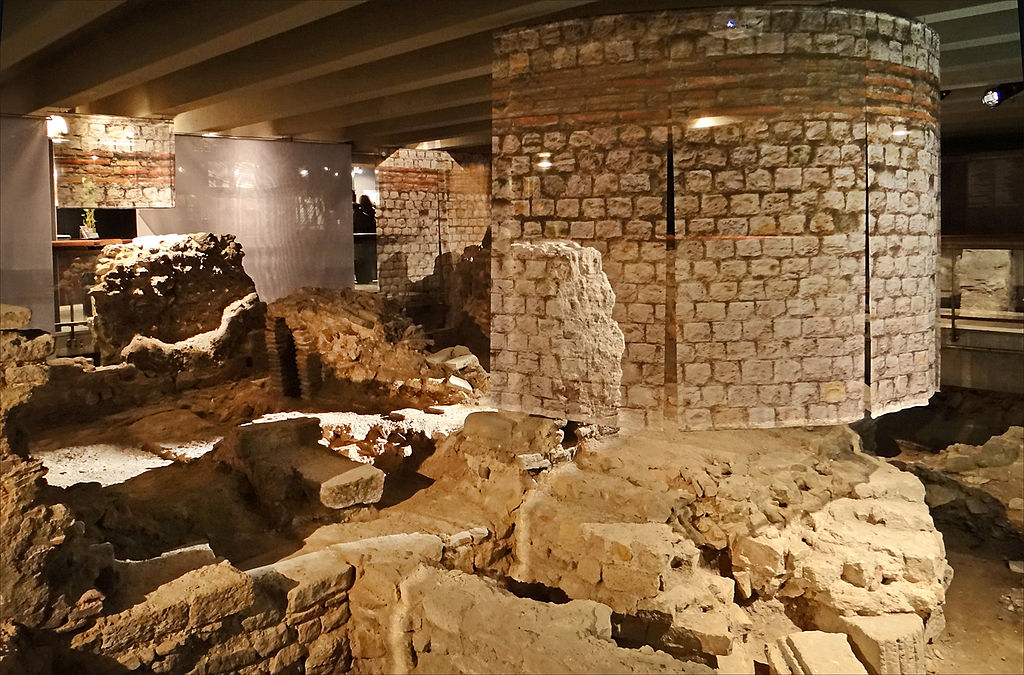

Crypte.jpg
"La crypte archéologique du Parvis de Notre-Dame (Paris) by dalbera from Paris, France
Wikimedia Commons


The Birth of the City of Light walk with Context Travel gave us an overview of the Roman city of Lutetia, located in the grounds of what is now Paris in the Ile de Cite and mainly in the left bank. This walk had many interesting facts about the Roman city. However, visiting the Crypte Archeologique was breathtaking. Our docent shared the history of the city of Lutetia. It was discovered when Parisians were digging to create more space, and fortunately found the remains of the ancient Roman city. The remains of the ancient city showed how stones were set up to create the city. It was interesting to learn the way Lutetia kept expanding in a circle, like rings of a tree trunk, with the Ile de la Cite in the center. Many Roman structures are still used in Paris, including; the Roman city planning main north-south-oriented main street called  cardo maximus. The process of seeing these ancient sites and then comparing it to the innovation of the buildings above throughout time made me think about what the world values. Paris appreciates the beauty of original buildings and makes them accessible to the public by having major museums free of charge for children and students. More places should follow this structure of having accessible sites for young people, it gives individuals a chance to explore and learn outside of school.   
DSC00168 - Copy.JPG
Louvre medieval fortress photo by Rebeca Vargas


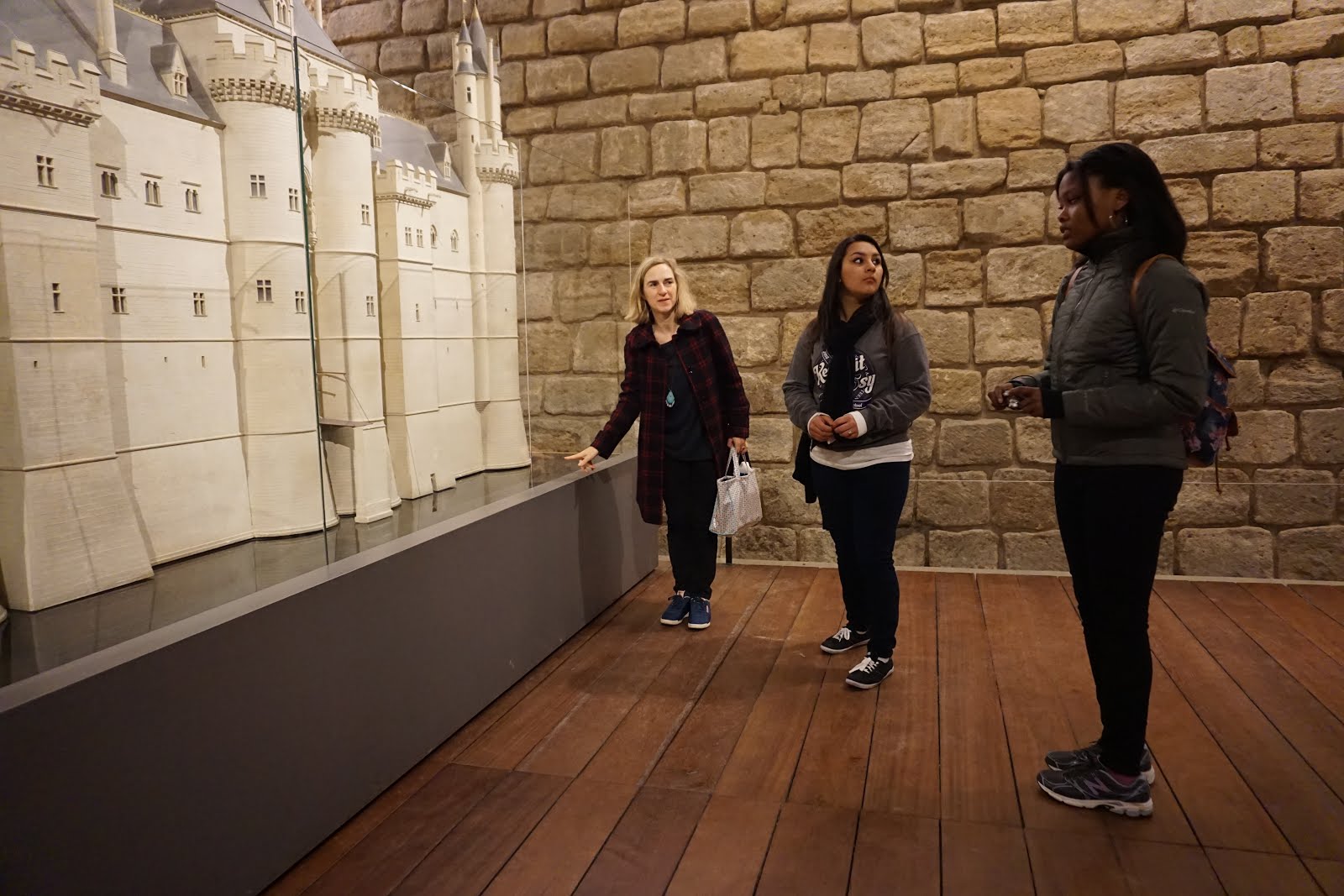
The Louvre Crash Course walking seminar started by entering the newly discovered medieval fortress under the famous museum. This part of the walk held my attention because it was underneath the Louvre for a long time until it was discovered in the 1980s, when the glass pyramid was added to the beautiful museum. After learning about the medieval fortress, the history of the rest of the Louvre fell into place.
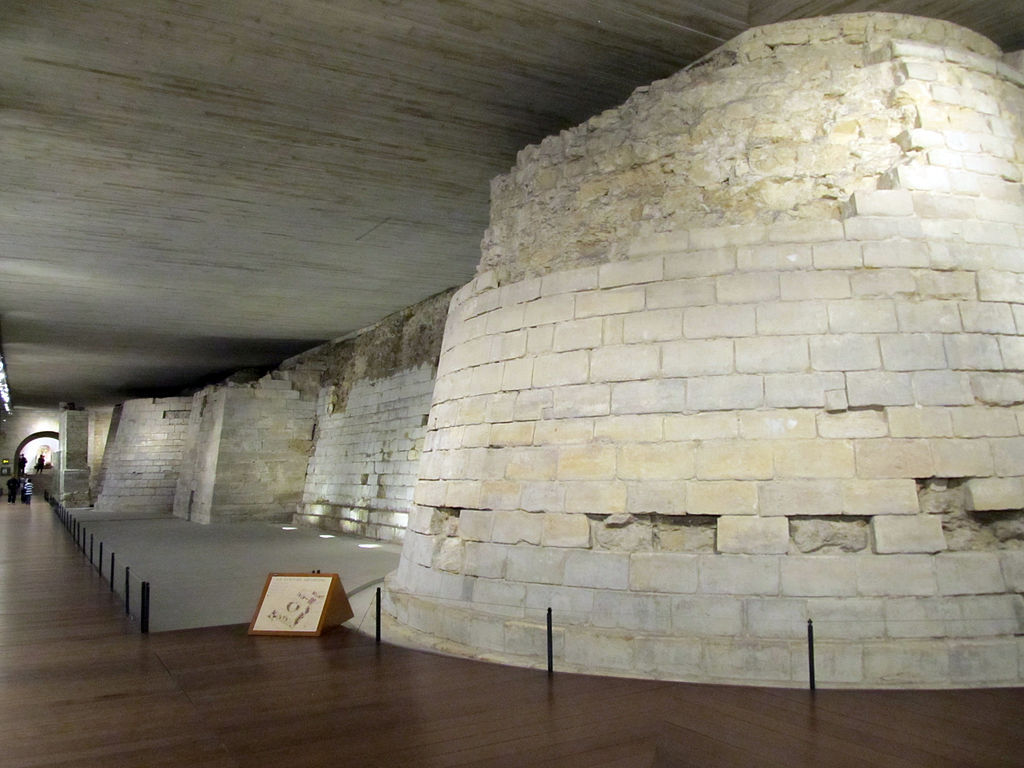
LOUVRE FORTRESS.jpg
"Fortress remains, Louvre, Paris June 2014" by daryl_mitchell from Saskatoon, Saskatchewan, Canada
 Fortress Remains-Wikimedia Commons


The amusing part of the discovery of the fortress is that it was not planned. The discovery of most remains of historical buildings in Paris are opened for the public to explore and learn about the past. I wonder if I start digging in my backyard, what will I find? I have grown an interest in the findings of historical buildings and objects. I have created a new challenge or added to my bucket list, to go back to the Louvre and learn about the artifacts there that we did not see today. Realistically, it will take me more than three days because the Louvre is huge, but I am up for the challenge and will return to the City of Light later in my lifetime. How long do you think it takes to go through the whole Louvre? 
0 comments

Notre Dame: Holy Museum?


Entrance to Notre Dame
Photo by: Jessica Hardy
   When thinking of Notre Dame, one might picture ornate spires, rusted gargoyles, and monumental entrances. I, too pictured this in my head, in anticipation for my visit to Paris. While I did found these characteristics to hold true, Notre Dame was also overrun by various less appealing characteristics as well.
   Upon approach, Notre Dame offers a spectacular entrance, second to none, characterized by three doors ornate with not only biblical and historical sculptures, but also royal motifs. The cathedral’s larger than life appearance excited my architectural passions and beckoned me to see more. Once inside, however, I witnessed first-hand the results of the presence of tourists and holy relics in one city. While the nave of Notre Dame is nothing less than an impressive showcase of both Romanesque and Gothic architecture, I was easily distracted by the presence of the crowd, murmuring and snapping pictures. I will not lie, I took pictures too; but I was constantly pervaded by the thought – this was not a gothic cathedral.
Ceiling at Notre Dame
Photo by: Jessica Hardy
  

   During medieval Paris, the Catholic clergy had Gothic Cathedrals constructed with massive stained-glass windows, colossal columns, complex ceilings, and dimmed lighting to create a supernatural experience for Parisian commoners, making the individual minute in comparison to the church. However, the presence of camera-snapping tourists and church-related advertisements coinciding with serious Catholics performing prayers and visible confessionals created a quite uncomfortable juxtaposition. Such a contrast provided no room for the reverence due to such a holy building. I had expected a holy cathedral and found a “holy museum”?
   
Alter at Sainte-Etienne-du-Monte
Photo by: Jessica Hardy
Even though Notre Dame did not satisfy my preconceived notions, I still highly recommend visiting the cathedral for its sheer scale as well as its biblical and historical symbolism. However,  I found that the smaller cathedrals around Paris present a more personal and traditional experience. For example, the Sainte-Etienne-du-Monte is a church in Paris, located on the Montagne Sainte-Geneviève in the 5th arrondissement, near the Panthéon. Although much smaller that Notre Dame, it contains the shrine of St. Geneviève, the patron saint of Paris. In addition, its’ smaller scale allows a more individual experience. I also found that I was able to enjoy the ceremonial mass, the lighting of the prayer candles, the symbols of the stained-glass windows, and the solemn atmosphere in a quieter, more traditional space. Who knew that I would find what I was looking for at Notre Dame in a smaller, less famous church – home to the patron saint of Paris? On second thought, that makes perfect sense.
Sunday, March 22, 2015 0 comments

2015 Scholarship Winners Prepare for Paris

Within 24 hours, Jessica Hardy and Rebeca Veliz will be in route to Paris. After three months of preparation classes, Context walks research, variety of readings and films, these two girls are ready to land in the City of Light.  Although it is challenging to write about a city that you have yet to see in person, each student wrote a pre-trip blog. Thanks to Dr. Jessie Voigt for working behind the scenes to assist students with their blogs. 

Check out Jessica's post, titled, From Cardboard Box to Notre Dame Cathedral


Wikimedia Commons: By Freepenguin


It is so funny how over time we grow and our minds tend to change. However, there are some passions that never leave our heads, those reoccurring dreams that we want so much to be a reality.
When I was about ten years old, I took the liberty to go through my mother’s mail. Upon finding an architectural magazine, I began to look through it… and every single house plan and style seemed to catch my attention. Some I fell in love with, some I hated. As a ten year old, I began to have an opinion about the world of architecture.
To read more, see Jessica's blog post, click link below.  Featured on Wandering Educators

Check out Rebeca's post, titled, Monet to Banksy: From Impressionist to Street Art
Auguste Renoir - Dance at Le Moulin de la Galette, 1876, oil on canvas, 131x175cm - Musée d'Orsay RF 2739 (derivative work - AutoContrast edit in LCH space). Wikimedia Commons

Cafés in Paris, France in the 19th century served as a place where individuals gathered to talk about painting, literature, and politics. In the corner of a Café, a group of young artists (who later became known as Impressionists) shared their dreams and aspirations in the art world. Their dreams included becoming professional artists, with their art works being accepted and displayed in the Salon, however they faced rejection from the art community. Many Impressionist artists, like Renoir and Monet, didn't go to traditional schools of painting - they went to studios that artists opened for young artist to use. Despite their rejections at the Salon, they didn't give up - and now their artwork is displayed in famous museums in Paris and around the world. Their ambition and grit helped them achieve success. The Musee d'Orsay is one of the museums that displays Impressionist works.
To read more, see Rebeca's blog post, click link below.  Featured on Wandering Educators


Wednesday, December 10, 2014 0 comments

Enhancing Qualities

        Starting this scholarship to Paris my ultimate goal was to grow in a few qualities before going to college. The three things I wanted to grow in was socially, intellectually, and to become more passionate. One thing I can say was that I've grown socially learning to talk to people and have an actual conversation without knowing them. As it was a competition, it felt nothing like one if anything I felt comfortable with all the others that were competing. I also expanded greatly my knowledge on the culture of Parisians. I have became more into interested in the art of architecture and paintings. learning to see the artist personality through their art seeing that they all had something distinct about them all which helped me come to appreciate them more. This helped me with becoming more passionate. I learned once you learn more about something the more interesting it becomes. I even learned things about myself competing in this scholarship. I feel as if this opportunity given helped me become more street smart. learning what popos are and knowing why the buildings in San Francisco are small or tall as they are. Then, with writing these blogs was nice because it helped us find a lot of information out on our own on something that we found interesting at the Paris seminars. It has even helped me with my writing skills, before this process I would be afraid to ever try to write a paper in two days. It has become increasingly easier to writ which is one thing I am most proud of being that in college I will have many writing assignments to do. That is where I feel I have enhanced intellectually. This competition for the scholarship to go to Paris was a great learning experience for me. I am proud of myself for going all the way through with it, it feels great that I actually did this scholarship and did not let my negative thinking or anyone else talk me out of it. I'm grateful to have slightly expanded in the qualities of becoming more passionate, intellectual, and social.
                                                                                        -Dazhawna Miller
0 comments

Fin


             I am very thankful for this experience. Each seminar depend my love and curiosity for different cultures. Through every seminar and after every blog I was happy because I gained more knowledge about another world.  The French culture showed that the arts and culture can be powerful influences internationally. I am happy with the knowledge I have gained because I know there is more to France
than what I’ve seen and I am excited about that. Every culture has some extraordinary asset and I want to acknowledge their gifts. This application was totally worth it because it challenged my ambition and increased my knowledge about outside worlds.

            Since the first blog I have grown tremendously and I thank the TYTT Scholarship for the application process. Writing several blogs have increased my exposer to the type of career I’d like to pursue, which is journalism. This application process challenged me because I had to write a blog and submit it at specific time. The time deadline has hinted what a journalist would have to go through. I will
have to face more deadlines as a journalist because stories will have to be published. Therefore I am honored to have experience the TYTT Scholarship because it is preparing me for my future.

             After every seminar I grew with a deeper passion to learn about different cultures. Learning about the French history, art, langue, and architecture enlighten me by realizing there was much more to my world. From the seminars I learned the French had to experience multiple revolutions to gain true independence. In the arts Picasso and Matisse were well known and created cubism and abstract paintings.  When speaking French one has to consider the gender and status of a person when being
addressed. In addition to the langue and culture French architecture was another form of art. The gothic cathedrals and the extravagant castles showed the exaggerated the importance of the build and its purpose.  Also I became intrigued and eager to learn more about other worlds because every culture has their own beauty and I need to experience all of them. The French seminars are only a tip to the ice burg of beautiful cultures I will encounter.

            I am very thankful for this experience. My love and curiosity for different cultures has increased and I am ready to learn more about all cultures. Each seminar and blog has increased the fuel to my burning passion for learning.  From the cathedrals to jazz I grew as I increased my knowledge about the French culture. I am delighted with the knowledge I have gained because I know there is more to France and I will gain the full experience one day in life. In conclusion I am very blessed and thankful for this opportunity and I will continue to learn and experience more cultures because every world has a beauty within them. Applying was worth it  challenged and inspired me to study more about different cultures. Thank you for this opportunity.


Las
La'Shay Hankerson

0 comments

A Puzzle of a Journey


Union Square IN San Francisco, California
Wikimedia Commons: Benson Kua
Yesterday, I sat in a room with 3,000 other individuals; and while this seems like an extremely claustrophobic situation, I assure you that we were all seated quite comfortably – some in the floor seating, some in the balcony. As the various notes and tones of Yo-Yo Ma soared through the auditorium and sauntered through my ears, I began to think: how did I get here? The obvious answer is that I had been driven through downtown Sacramento, dropped off in front of the Memorial Auditorium, and given a balcony ticket; but, I am not talking about that am I? My memories brought me back to the day that had submitted my application for the Context Travel scholarship. I knew what I was looking for – an opportunity to delve into a foreign culture and increase my knowledge of the world around me – or so I thought. However, this process has taught me a subtle lesson – don’t judge a book by its cover! Paris is known as the city of lights, and to me it was the brewing grounds for the notorious French Revolution as well as a world-renown pompous cuisine. However, hours of research highlighted more subtle and back-alley events, such as the building of a mock Paris during World War I.
 

Chinatown
Wikimedia Commons: Toffel (own work)
Slowly, I began to learn that there were more jewels, such as art and opera, hidden under the rugged surface of Parisian history. In addition, traveling to San Francisco allowed me to experience the city at a more personal level. Sure, I was traveling with a group; but at the same time I found myself alone and entranced, as each sight presented its garments of brick, wood, marble, and Shanghai collectables. Strolling through San Francisco’s Little Italy, Chinatown, and Vietnamese corridors and standing in the city’s Catholic cathedral and Union square showed me that I had only viewed San Francisco as an everyday city, something it was not. This reality check has helped me to assess my actions in my personal life. I quickly found that I had been criticizing my circumstances based on a general stereotype rather than looking for the positive aspects. Wow! Now, I found myself under the voice of the great Yo-Yo Ma, the last piece to this puzzle-of-a-journey. He believes that the secret to all of his musical fame and acclamation is the fact that he “found the code” within his music. In other words, Ma went directly past the technicality of the musical piece to access the emotion and the “words” behind it. In my everyday life, that means purposely looking for the positive in my circumstances; for only then, as Yo-Yo puts it, will “I find meaning.”


Panorama of San Francisco
Wikimedia Commons: JohanSonn (own work)
0 comments

Unforgettable Experience

This experience has allowed me to grow personally throughout the process. I have become a little more adventurous with the little things in life that describes me. I now try foods that I have never eaten, hoping that I will enjoy the taste. What made me do this now was because of the French grilled cheese I ate at La Boulance, which had peasant bread, cheddar, and provolone. I enjoyed the sandwich, even though I have never had provolone or peasant bread, but I surprisingly enjoyed it regardless.
Now whenever I hear about the different types of French artists, such as Monet, Manet, Picasso, Gertrude, and so on; I suddenly remember the seminars and tell the people around me or the person who mentioned the artist about the seminars I went to. One time, this substitute for my advanced engineering class talked about how the flying buttresses of the Notre Dame Cathedral and asked if any of the students knew about it. I immediately remembered about what I learned from the history seminar and mentioned that I knew about the buttresses and where I learned them from, I was glad at the fact that I remembered the parts of the cathedral from the seminar.
The French language seminar also helped me grow personally, while I was taking the SAT last Saturday and McClatchy, my testing room was in a French class. It was such ironic because of the familiar French words I saw around the room that I learned in the seminar. This made me remember of all of the words and sentences I learned with Ms. Bowie. Every time I had a mini-break from my test, I would continuously look around the room and see all of the French words, and I’ve asked myself, “Maybe I should look into learning French, since it’s similar to Spanish in a way.”

The competition for the wonderful trip to Paris has molded my mind with all of the things I learned in the seminars and the San Francisco trip. I have grown in my own ways personally and hope to use this knowledge in the future to help me in college. I enjoyed participating in this competition and learning about French culture and wish good luck to everyone. J
 
;