Sunday, November 2, 2014 0 comments

From Horrors to Bliss

WWI was one of the most dramatic moments throughout world history. Uses of trench warfare seemed to be a useless and fearful military tactic as lines of soldier lay next to each other, cramped in small crevasses, while the enemies (Germans) are attempting to annihilate their foes (Americans, French, Britain, Russia, and Italy) with their newly found technological machine, the machine gun. This weapon simply devastated anybody who stands in its way with its rapid firing rate, giving it an advantage to the weapons that constantly needed to be reloaded. Though the war was stalemate, there were still problems growing within the trenches, diseases developed as rodents scurried through the tight spaces, and the decaying of corpses, leaving horrendous images in the minds or soldiers. Many soldiers of the war witnessed their comrades getting torn into pieces from gunfire or mines, seeing them die right in front of their eyes scarred their mentality; eventually leading to PTSD. Meanwhile at their home country, including America, nationalism grew rapidly as propaganda encouraged young minds to fight and die for their country by enlisting in the war.
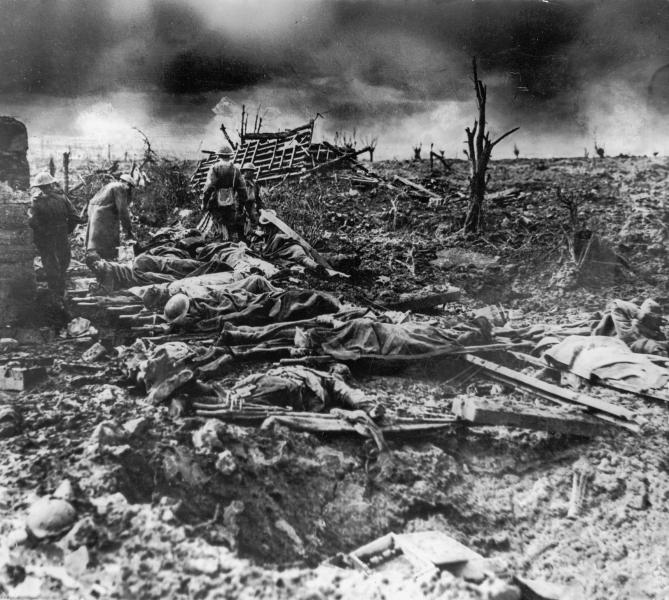
The battle at Passchendaele. Photo by Adam Hochschild.
Those soldiers who were in the war and began to write their experiences were known as the “Lost Generation”.  An author named Wilfred Owen wrote a poem, Dulce Et Decorum Est (Sweet and Proper), about his experience during the war, giving specific imagery such as, “He comes at me, guttering, choking, drowning.” Giving explicit details about his comrades and other soldier being killed in the line of duty, expressing the emotions he possessed during the time through his poem, giving a fearful and dramatic tone. I personally felt this way reading this, as if I was in the moment Wilfred was in.

Modernism came during the 19th and early 20th century, mainly in Europe and North America. It is characterized by a self-conscious break with traditional styles of poetry and verse. The Modernist literary movement was driven by the desire to disregard traditional modes of representation and express the new sensibilities of their time. Thinkers such as Sigmund Freud and Karl Marx questioned the rationality of mankind, questioning it and seeing what it does in society.

Gertrude Stein was an American Modernist writer who wrote unusual things, such as the autobiography of her partner, Alice B. Tokas. It’s unusual in that, she wrote about an autobiography, (basically a story about you) about another person. She also collected various Modernist arts and placed it all around her house, which kind of became a museum of Modernist art. Gertrude basically had “hangouts” at her salon, where many famous artists came and mingled. It’s where Picasso and Matisse met, which began their lifelong friendship.
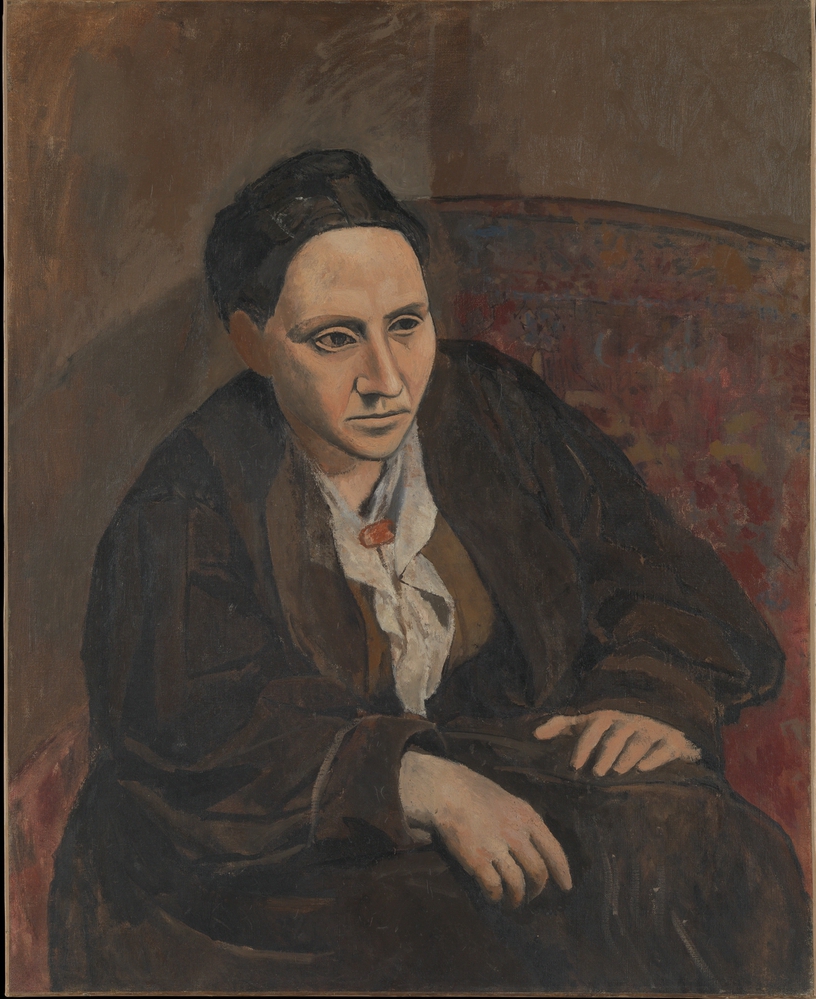
Pablo Picasso, Portrait of Gertrude Stein.


Jazz came during the early 20th century; this type of music was mainly improvised while playing, and was not as well-constructed as classical music. Sidney Bechet was an American jazz saxophonist, clarinetist, and composer who was one of the first important soloists in jazz. Bachet recorded many works such as “Wild Cat Blues” and “Kansas City Man Blues”.  I found it interesting that Bachet interpreted and played each of his works uniquely and with outstanding creativity, which takes a large amount of work to accomplish. There was more freedom in jazz by allowing each musician  to have solos so that they are basically the “hero” of the song, giving more energy into  it.
0 comments

How can a WAR make something SO beautiful????

"I have been in the trenches again and I am one of the very few who is still alive and haven't a scratch on me. My regiment the 106th Infantry is wiped out. How I ever got out alive is more than I can tell. My Sargent, my corporal, my squad all got it but me, even my Lieutenant was wounded three times. The boys of the line companies got to their objective which was the Hindenburg Line, held it and the few that was left smashed the Hindenburg Line the next morning and kept going on."(Peter Schaming, Jr.). 
 
Wikimedia commons: John Roberts
World War I 
Hello bloggers, my name is Roynell Anderson, and that was the introduction of Mr. Schaming's autobiography about World War 1. Peter Schaming was living in Paris during the time of World War 1 and shared his experiences with Citizen Soldiers, a website that haves different autobiography of surviving soldiers from WW1. This isn't the only story about the horrible-shocking events that happened. Some other stories tell about people that came back from the war with missing legs, missing arms, and had shell shock (also known as posttraumatic stress disorder.) As you can see war wasn't like a walk in the park. It was horrible and it had an negative impact on the French people. People started to drink and stop going churches: welcome to the lost generation. 
The Lost Generation 
 "What are all the clocks for?" she asked.  "They show the hour all over America." "Don't kid me."  
We turned off the Avenue up the Rue des Pyramides, through the traffic of the Rue de Rivoli, and through a dark gate into the Tuileries. She cuddled against me and I put my arm around her. She looked up to be kissed. She touched me with one hand and I put her hand away. 
Wikimedia Commons:Frank Thompson 
 
"Never mind."  "What's the matter? You sick?" "Yes."  "Everybody's sick. I'm sick, too." We came out of the Tuileries into the light and crossed the Seine and then turned up the Rue des Saints Pères"You oughtn't to drink pernod if you're sick." "You neither."  
"It doesn't make any difference with me. It doesn't make any difference with a woman."(Ernest Hemingway) 
Welcome to the lost generation, a time period where you can confuse people with your writing and get away with it. It was also the time to drink like there is no tomorrow. That's probably why a lot of people died during this the lost generation. "The Sun Also Rises" by Ernest Hemingway, shows a great example of the lost generation. During the story the author writes about meeting a girl that he have no connection with. During that time, people would write about this and will find a way to make their stories sound interesting by hooking up with girls that where younger than them. The lost generation is similar to the roaring twenties because during the roaring twenties, people was drinking more and changed the way Americas see women's views. 
If I got a chance to go back in time, I would go to the time of the lost generation, hands down. The lost generation seems like a fun time in history to go visit. It interested me that the French was able to turn a negative into a positive. After fighting in the war, the lost generation was a time for Paris to have fun and don't care about what people say. I wish that America can be like the lost generation. For now, I just have to keep on dreaming and watch Midnight in Paris and The Great Gatsby.   
-Roynell Anderson
0 comments

Drink, Weep, Sleep, Repeat...


          When you hear the word war, what are a few things that pop into your head? Is it death, the ringing of an explosion, the strong smell of lead and blood, the low hum of airplanes and helicopters, or the distant echo of gunfire? Whatever your imaginations perceive about this word, nothing can compare to actually witnessing it or being on the front lines. Few know the true horrors of war and even fewer return mental stable or unharmed. World War I was a traumatic event that shifted Europe from a more traditional time to more modern. Traditional Europe was ruled by a monarchy or aristocracy. People followed strict moral guidelines set in place by the church and even stricter social hierarchies given to them by birth. After the war, there was less of a moral authority, social status was based on wealth, and people drank away their sadness and grief. World War I, also referred to as the Great War, altered people’s views of tradition and caused them to question everything they knew.
Wikimedia Commons: Rcbutcher
          La Belle Époque, a time of happiness and optimism, was shattered by the war. Many soldiers returned with severe trauma and suffered from shell shock, a condition closely related to PTSD. These soldiers were referred to as the Lost Generation. The war changed how many people viewed the world. Before the war, everything made sense and after people were confused and frustrated and displayed their emotions through literature, music, and art. Homes and towns were families flourished, children played, and bonds were built were destroyed. Churches were reduced to nothing but a pile of rubble and ashes. These horrific images caused an entire cultural change in Europe.
          People began to explore and experiment with different styles of art and writing. Poetry became darker and art became more unique. An example of this would be the poem “Dulce Et Decorum Est”, by Wilfred Owens. Owens describes a horrifying image of the war and states that people would not tell their children how glorious war is if they knew the truth. The emotion of this poem is powerful enough to place you in the shoes of a soldier fighting for his life in the trenches. The years after the war also brought about the development of jazz music and various other forms of art.
Wikimedia Commons: Freimut Bahlo
          Even though this was a depressing time, I would argue that this shift to a more modernist culture was beneficial. Not only did people begin thinking for themselves, they started to move away from tradition and started doing what they’re hearts and minds dictated. Sometimes, disconnecting from the world to find out who you truly are is better than following the path society has laid out for you; don’t you think?

~DeRael               
0 comments

Lost, but Never Found

Untitled, Bettaman Corbs


Have you ever felt so lost and never found before? I'm sure you have had that feeling at least once in your life. Well, towards the end of the belle époque period in France and well after WWI the French became lost and not found also known as the Lost Generation.
 
It's hard to imagine what the French went through. Just imagine you just came home from treacherous war where many people had their life harshly taken away from them. Where many people lost limbs and given senses. And after such a sight, you return home just to find the majority of it destroyed. On top of that, half of your family is missing or dead. Wow, what a sight right?


Untitled, Harry
 
The experiences of WWI led to a well collective trauma that was shared with many European countries and even America (not that we  aren't lost already as of today). Everyone from everywhere was feeling lost, but where they ever found. What healed this oh so lost generation?


America's New Lost Generation, Gordon Duff

 
Just to see an example of being lost, I find it the perfect time to show an example of recent America being "lost" just to get you an even bigger picture of overall the Lost Generation.
 So now that you have a bigger picture of the lost ones back then, try now to imagine those same lost ones making art. Do have an idea of what that art would look like? Let me show you some examples.


Untitled, Tom McGuinness

McGuinness was a minor yet talented artist. He wanted to communicate with those around him. As you can see McGuinness uses a lot of dark colors; it was a dark period for many. The subject of the painting is a man and a woman who look very gloomy. You will also notice all the ruin around the people. I admire that McGuinness uses red since the color itself is known for catching the audience's attention.


 Untitled, Christian Guemy
Here's another idea of what the Lost Generation painted like. Does this style remind you of someone? This painting seems as if it were inspired by Pablo Picasso. The subject would be classified as human, but where are the arms? A little rebellious if you were to ask me. Look at the colors that are used above. Not as gloomy as the first painting I showed you, but this wouldn't be known as upbeat and happy either.
After WWI, the Lost Generation then experienced Modernism where mainly North America and Europe changed tradition to "Make it New". The term "New" can be interpreted as trying and experiencing undocumented things, even if they were under a ludicrous category. You might be wondering, well when do things brighten up? That's an excellent question that I'm not too aware of. But I do know that eventually Jazz was born in contrast to classical. Another way to look at the Lost Generation is that their mistakes from Modernism and overall are outcomes we can now avoid. Eventually the lost Generation was found but will never be forgotten.
Alaze

0 comments

The Lost Generation: The Unsung Lyrics of Jazz


Sidney Bechet
Wikimedia Commons: William P. Gottlieb
When you think of jazz, what comes to mind? Acrobatic melodies floating across a coffee shop, creating a romantic euphoria and perfect complement to the whiffs of the cozy, delightful drink itself. The music stops. The double bass gently returns with a calming “dum-bum-bum-bum-da-da-de-dum-bum”. So simple, yet so complex. So individual, yet so communal at the very same time. Similar was the music of Sidney Bechet, who entranced the Théâtre des Champs-Élysées with the glories of jazz, as he and his audience danced onto magical tangents, explored through his musical variations. 


Royal Irish rifles in the Battle of the Somme, WWI
Wikimedia Commons: Imperial War Museums, UK
Born in 1897, Bechet, although an American saxophonist, clarinetist, and composer, brought his unique and individual personality to Montmartre, Paris. As one of the first notable jazz players, he was quite innovative for his time. Ah, but what time was it? To answer this question, we must travel back four or so years to the date July 28, 1914. The words of Wilfred Owen illustrate this time best. “Men marched asleep. Many had lost their boots but limped on, blood-shod. All went lame; all went blind; drunk with fatigue; deaf even to the hoots of disappointed shells that dropped behind. If in some smothering dreams you too could pace behind the wagon that we flung him in, and watch the white eyes writhing in his face, his hanging face, like a devil’s sick of sin; if you could hear, at every jolt, the blood come gargling from the froth-corrupted lungs, obscene as cancer, bitter as the cud of vile…” These were the horrors of WWI, and the artists to follow were named the Lost Generation. Yes, lost they were; thrown away from the soothing melodies of religion, and jolted into the requiem of war.

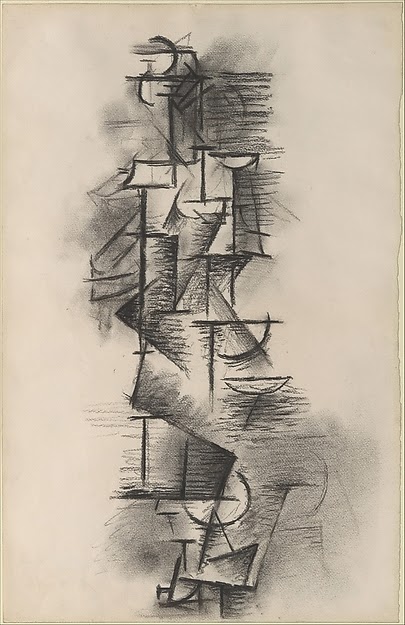
Standing Female Nude by Pablo Picasso
(1910)
Wikimedia Commons:
Metropolitan Museum of Art
Enter Sidney Bechet, a complicated jazz musician; enter Gertrude Stein, a gay novelist who lived openly with her partner; enter Picasso and Matisse, painters of reality and imagination with complex shapes; enter Ernest Hemingway and F. Scott Fitzgerald, both heavy drinkers who conveyed the disjunction of human society through their writing. Each of these artists have one thing in common – they lived like the “dum-bum-bum-bum-da-da-de-dum-bum” of the double bass followed by the blare of trumpet and the liquid voice of the saxophone. If the hierarchal nature of classical music embellished the traditional ideals of the generation before them, then the varied melodies and rhythms of jazz defined the post-war generation. Improv was the key. The Lost Generation was a tossed salad, a jumble of social experiments and falters in an effort to make sense of 20th century life.
So the next time you hear the romantic, peaceful, and yet tangential and sporadic melodies of jazz, maybe listen a little closer to the unsung lyrics of the “Lost Generation”.
0 comments

27 Rue De Fleurus

Yesterday Matisse invited me to a gathering on 27 Rue De Fleurus so I could meet some of his friends like Renoir, Picasso, and Cezanne. How exciting would that be to just meet up with a group of well known artist. Especially Picasso. with his abstract and complex art! Well that is Gertrude Stein, an  American writer who moved to Paris in 1903. She was a literary innovator and pioneer of modernist literature. In addition, she was a collector of modernist art and was good friends with many artist including Matisse and Picasso.


"Gertrude Stein". Pablo Picasso.Oil on canvas.39 3/8 x 32 in. (100 x 81.3 cm)The Metropolitan Museum of Art. In New York.

The lost Generation was a time period where Parisians lost guidance in society. In traditional French society, the church and government usually served as a way to show people how their life should be and gave them a bit of structure. However, after World War 1, many people died and some came back home disabled, without an arm or leg. Many people lost their family members and were left alone in a city that was trying to recover from the war. People lost hope and faith after losing loved ones. Also many people started to experience a variety of things that varied from sexual experimenting to experimenting on writing structure.

Gertrude Stein is a good example of the people who started to experiment different things. For instance, she was a lesbian and in a city where religion was a part of society homosexuality was not morally right however she had a lifelong companion, Alice B. Toklas. She wrote The autobiography of Alice B. Toklas, in Toklas voice which reflected memoir of her Paris years. In a way this was weird because an autobiography is the life of the person writing it but in this case Stein wrote it for Toklas. Also in her writing she rejected linear, time-oriented characteristics of writing from the 19th Century. This shows how her writing shifted to a different structure just like other writers including Ernest Hemingway. Hemingway in, The Sun Also Rises, uses the iceberg theory where he leaves you thinking and confuses you. Overall, in my opinion the changes many people faced in Paris was a result from not feeling comfortable or in better words not feeling connected to their cultural heritage, which led them to trying new things.
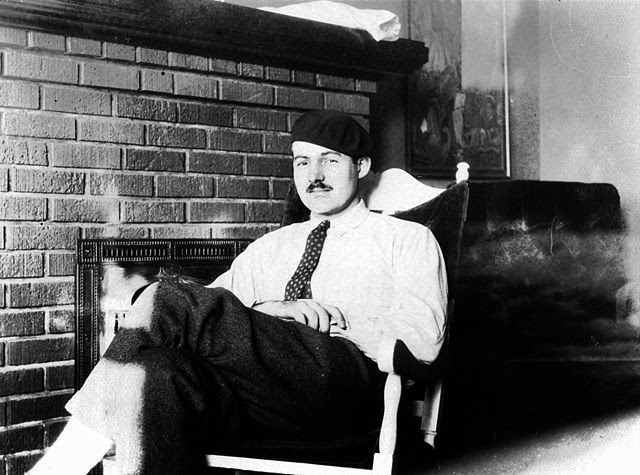
"Ernest Hemingway, Paris, 1924" by Not specified, owned by John F. Kennedy Presidential Library and Museum, Boston Licensed under Public domain via Wikimedia Commons
I wonder why Gertrude Stein moved to Paris. Yesterday in the seminar many said maybe because Paris France accepts diversity and being different. I mean you can see it during the lost generation. Many people broke away from rules and morals set by the church and government authority. They became different and unique from other generations. It is true that the United States is different and diverse but in the history of the United States many people were not accepted or treated right due to the fact that they different. Maybe it still is around till this day many are systematically oppressed without knowing it. When I was younger I was told to go back to my mother country because of the color of my skin and the way I talked. It was hard for me to feel accepted and as a result I started to change. Although I knew that I was an American citizen, I would not speak Spanish at home or take the lunch my mother made me to school. I was rejecting my culture just to be accepted in society. Now that I have grown and learned more about my culture I am proud of who I am and I don't want to change that. The lost generation lost their cultural heritage but the new generations following them have improved and accept different people. This is what I want. I want to experience acceptance for who I am. To be welcomed to a beautiful city and admire its history and art by connecting everything that I have learned in this past month and a half to the things I will see in Paris. Why do you think Gertrude Stein moved to Paris?

-Rebeca


Saturday, November 1, 2014 0 comments

Enchanted but Repelled from it...

            Out with the Old in with the bluegoodbye clouds of gray and hello skies of New. The idea that influenced me in todays seminar was the theme of Modernism vs. Tradition. This was a time where people started to self- consciously break the traditional style. Now during the Modernism era,  modernists tended to experiment with a lot of things, from classical to jazz music, to their old ways to their new ways of living life. How all the rules where thrown out and people did what they felt in that very moment.

          An American writer named Gertrude Stein wrote novels, plays, and poetry, she was a pioneer of the Modernists literature. (funfact: she was aka the collector of Modernists Art ). She wasnt the only one who was inspired, there was Sigmund Freud who was a psychologist and he wanted to understand how and why people did what they did. There was also Karl Marx who focused on class interaction and history. They both questioned the rationality of mankind.
         
            This theme is very intriuing because it makes me want to know more, it leaves me challenging things I have been taught. In the seminar today we read a few pages from The Sun Rises by Ernest Hemingway and The Great Gatsby by F. Scott Fitzgerald. In The Sun Rises it gives you an insight of how lost people were and how people lost their connections to the world. In The Great Gatsby it gives you the insght of how spontaniously informal the parties get in that era. They both are similar in the sense of Modernisim vs. Tradition because in the movies and books they describe this frenzy of Enchanting but repelled from it. Its Enchanting because everything is starting over, new music, new arts, new way to epress yourself however its  Repelling because everything was so new, some what choatic, and newly expressed with no limits because people wanted to get rid of old traditions.

       This particular idea of Modernism vs. Tradtiton gives me a Frenzy about possibly going to Paris not only because its a beatiful city, but because its a learning experience. To see what the people in Paris see on a everyday bases of the Romance, Economics, and the different change in the Atomosphere when you visit historical Monuments, Arts, and the Buildings.
    --SetaAtes
 
;